


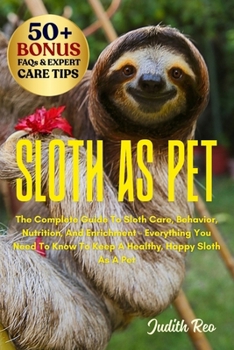
Sloth as Pet: The Complete Guide To Sloth Care, Behavior, Nutrition, And Enrichment - Everything You Need To Know To Keep A Healthy, Happy Sloth As A
No Customer Reviews

Introduction to Sloths Sloths are among the most fascinating and enigmatic creatures in the animal kingdom. With their deliberate movements, seemingly perpetual calm, and unique adaptations for arboreal life, sloths captivate the imagination of people around the world. Their leisurely lifestyle contrasts sharply with the fast-paced world we live in, and this very quality has made them icons of curiosity, serenity, and even humor in popular culture. In this chapter, we will explore sloths in detail, covering the diversity of species, their natural habitats and behaviors, and why humans are so fascinated by them.
Overview of Sloth Species
Sloths belong to the order Pilosa, family Megalonychidae (two-toed sloths) and Bradypodidae (three-toed sloths). While the name "sloth" often evokes images of a single type of animal, there are actually several species, each with unique characteristics and adaptations. In total, there are six extant species of sloths, categorized broadly as either two-toed or three-toed.
Two-Toed Sloths
Two-toed sloths are members of the genus Choloepus. Despite their name, they have two long, curved claws on their front limbs, which aid in climbing and hanging from trees. They are slightly larger than three-toed sloths and are primarily nocturnal, meaning they are more active during the night. Two-toed sloths have a more varied diet that includes leaves, fruits, and even small animals on occasion. Their digestive system is highly specialized to break down tough foliage, and they possess a slow metabolism that allows them to survive on low-calorie diets.
The two species of two-toed sloths are:
1. Linnaeus's two-toed sloth (Choloepus didactylus) - Found mainly in northern South America, particularly in countries like Brazil, Suriname, and Guyana.
2. Hoffmann's two-toed sloth (Choloepus hoffmanni) - Native to Central America, ranging from Honduras to western Colombia and Ecuador.
These sloths are known for their strong limbs, flexible necks, and the ability to hang upside down for hours without exerting much energy. Their movements are deliberate, almost meditative, reflecting their low-energy lifestyle.
Three-Toed Sloths
Three-toed sloths belong to the genus Bradypus and are characterized by their three claws on each limb. They are generally smaller and lighter than two-toed sloths and tend to have a more specialized herbivorous diet, consuming mostly leaves from a limited variety of trees. Three-toed sloths are diurnal or nocturnal depending on the species and location, and they are highly adapted to life in the treetops.
The three species of three-toed sloths are:
● Brown-throated sloth (Bradypus variegatus) - The most widespread species, found across Central and South America, including countries like Costa Rica, Panama, and Brazil.
● Pale-throated sloth (Bradypus tridactylus) - Primarily located in northern South America, especially the Guianas and parts of northern Brazil.
● Maned sloth (Bradypus torquatus) - Native to the Atlantic Forest of Brazil, this species is rarer and classified as vulnerable due to habitat loss.
● Pygmy three-toed sloth (Bradypus pygmaeus) - Found exclusively on Escudo de Veraguas Island in Panama, this species is critically endangered and extremely small in size compared to its relatives.
Three-toed sloths are distinguished not only by their claw number but also by their facial markings, shorter limbs relative to body size, and slower overall movements. Unlike two-toed sloths, their metabolism is even slower, and they spend most of their lives hanging upside down in the forest canopy.
Overview of Sloth Species
Sloths belong to the order Pilosa, family Megalonychidae (two-toed sloths) and Bradypodidae (three-toed sloths). While the name "sloth" often evokes images of a single type of animal, there are actually several species, each with unique characteristics and adaptations. In total, there are six extant species of sloths, categorized broadly as either two-toed or three-toed.
Two-Toed Sloths
Two-toed sloths are members of the genus Choloepus. Despite their name, they have two long, curved claws on their front limbs, which aid in climbing and hanging from trees. They are slightly larger than three-toed sloths and are primarily nocturnal, meaning they are more active during the night. Two-toed sloths have a more varied diet that includes leaves, fruits, and even small animals on occasion. Their digestive system is highly specialized to break down tough foliage, and they possess a slow metabolism that allows them to survive on low-calorie diets.
The two species of two-toed sloths are:
1. Linnaeus's two-toed sloth (Choloepus didactylus) - Found mainly in northern South America, particularly in countries like Brazil, Suriname, and Guyana.
2. Hoffmann's two-toed sloth (Choloepus hoffmanni) - Native to Central America, ranging from Honduras to western Colombia and Ecuador.
These sloths are known for their strong limbs, flexible necks, and the ability to hang upside down for hours without exerting much energy. Their movements are deliberate, almost meditative, reflecting their low-energy lifestyle.
Three-Toed Sloths
Three-toed sloths belong to the genus Bradypus and are characterized by their three claws on each limb. They are generally smaller and lighter than two-toed sloths and tend to have a more specialized herbivorous diet, consuming mostly leaves from a limited variety of trees. Three-toed sloths are diurnal or nocturnal depending on the species and location, and they are highly adapted to life in the treetops.
The three species of three-toed sloths are:
● Brown-throated sloth (Bradypus variegatus) - The most widespread species, found across Central and South America, including countries like Costa Rica, Panama, and Brazil.
● Pale-throated sloth (Bradypus tridactylus) - Primarily located in northern South America, especially the Guianas and parts of northern Brazil.
● Maned sloth (Bradypus torquatus) - Native to the Atlantic Forest of Brazil, this species is rarer and classified as vulnerable due to habitat loss.
● Pygmy three-toed sloth (Bradypus pygmaeus) - Found exclusively on Escudo de Veraguas Island in Panama, this species is critically endangered and extremely small in size compared to its relatives.
Three-toed sloths are distinguished not only by their claw number but also by their facial markings, shorter limbs relative to body size, and slower overall movements. Unlike two-toed sloths, their metabolism is even slower, and they spend most of their lives hanging upside down in the forest canopy.
Format:Paperback
Language:English
ISBN:B0FPV3HYNW
ISBN13:9798262716609
Release Date:September 2025
Publisher:Independently Published
Length:158 Pages
Weight:0.48 lbs.
Dimensions:0.3" x 6.0" x 9.0"
Customer Reviews
0 rating
Copyright © 2025 Thriftbooks.com
Terms of Use | Privacy Policy | Do Not Sell/Share My Personal Information | Cookie Policy | Cookie Preferences | Accessibility Statement
ThriftBooks ® and the ThriftBooks ® logo are registered trademarks of Thrift Books Global, LLC
ThriftBooks ® and the ThriftBooks ® logo are registered trademarks of Thrift Books Global, LLC
