


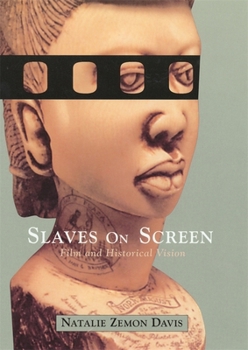
Slaves on Screen: Film and Historical Vision

Select Format
Select Condition 
Book Overview
The written word and what the eye can see are brought together in this fascinating foray into the depiction of resistance to slavery through the modern medium of film. Natalie Zemon Davis, whose book The Return of Martin Guerre was written while she served as consultant to the French film of the same name, now tackles the large issue of how the moving picture industry has portrayed slaves in five major motion pictures spanning four generations. The potential of film to narrate the historical past in an effective and meaningful way, with insistence on loyalty to the evidence, is assessed in five films: Spartacus (1960), Burn (1969), The Last Supper (1976), Amistad (1997), and Beloved (1998).
Davis shows how shifts in the viewpoints of screenwriters and directors parallel those of historians. Spartacus is polarized social history; the films on the Caribbean bring ceremony and carnival to bear on the origins of revolt; Amistad and Beloved draw upon the traumatic wounds in the memory of slavery and the resources for healing them. In each case Davis considers the intentions of filmmakers and evaluates the film and its techniques through historical evidence and interpretation. Family continuity emerges as a major element in the struggle against slavery. Slaves on Screen is based in part on interviews with the Nobel prize-winning author of Beloved, Toni Morrison, and with Manuel Moreno Fraginals, the historical consultant for The Last Supper. Davis brings a new approach to historical film as a source of "thought experiments" about the past. While the five motion pictures are sometimes cinematic triumphs, with sound history inspiring the imagination, Davis is critical of fictive scenes and characters when they mislead viewers in important ways. Good history makes good films.Format:Paperback
Language:English
ISBN:0674008219
ISBN13:9780674008212
Release Date:March 2002
Publisher:Harvard University Press
Length:176 Pages
Weight:0.54 lbs.
Dimensions:0.5" x 5.1" x 7.9"
Customer Reviews
1 rating
Excellent analysis
Published by Thriftbooks.com User , 24 years ago
But chosing five mainstream feature films, Davis has allowed the average reader into the rather closed world of film criticism and historical analysis. A historian herself, Davis applies performance theory to examining how feature films do and can be an educational vehicle for history. Five films are examined: Spartacus, Burn!, The Last Supper, Amistad, and Beloved. The last four all deal with slavery in the "new world" of the Americas. Davis points out incidents where historical fact has been replaced with fiction, where events have taken on a modern twist, and how film-making has hindered or aided in connecting the past to the modern audience. None of the five films are perfect but Davis feels they are good overall because their goals are all to make the audience feel what the slaves or freed felt so that we can form a better understanding of a social institution that currently is frowned upon in most of the developed world. It would have been better if she spent more time on the history of the period and events each movie covered but for an early attempt at using performance theory in history, it is an excellent start.
Copyright © 2026 Thriftbooks.com
Terms of Use | Privacy Policy | Do Not Sell/Share My Personal Information | Cookie Policy | Cookie Preferences | Accessibility Statement
ThriftBooks ® and the ThriftBooks ® logo are registered trademarks of Thrift Books Global, LLC
ThriftBooks ® and the ThriftBooks ® logo are registered trademarks of Thrift Books Global, LLC
