


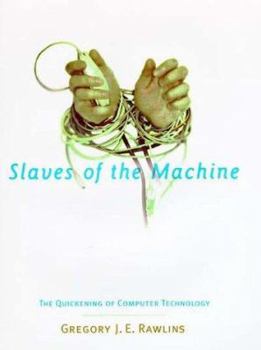
Slaves of the Machine: The Quickening of Computer Technology

Select Format
Select Condition 
Book Overview
In Moths to the Flame, Gregory J. E. Rawlins took lay readers on a tour of the exciting and sometimes scary world to which compters are leading us. This new book is for those who are new to computers and want to know what is under the hood. It shows what computers can do for us and to us. It tells the story of how we became slaves to our machines and how our machines may one day become slaves to us. Written in an accessible, anecdotal form, Slaves of the Machine presents the birth of the computer, charts its evolution, and envisions its development over the next fifty years. Each of the six chapters asks a simple question: What are computers? How do we build them? How do we talk to them? How do we program them? What can't they do? Could they think? After answering its question, each chapter views its topic in terms of the state of the art as of 1997 and into the near future. Rawlins successfully demystifies the computer --the first step away from slavery to it.
Format:Hardcover
Language:English
ISBN:0262181835
ISBN13:9780262181839
Release Date:January 1997
Publisher:Mit Pr
Length:145 Pages
Weight:0.47 lbs.
Dimensions:9.5" x 0.8" x 6.5"
Customer Reviews
2 ratings
Ccomputer history, philosophy and speculative science at their best
Published by Thriftbooks.com User , 22 years ago
_____________________________________________ Prof. Rawlins has written an elegant small book on the history and future of computers, ranging from Charles Babbage's Analytical Engine (1842) to future machine intelligence. His book joins such distinguished predecessors as Hans Moravec's "Mind Children" and Eric Drexler's "Engines of Creation": speculative-science books more interesting (and certainly more rigorous) than most science-fiction. From Babbage, Dr. Rawlins turns to Alan Turing, "another farsighted English mathematician who dreamt of machines that manipulated information... Like Babbage before him, Turing saw so far ahead that he never understood why he had to explain everything he foresaw to the government." Like Babbage, he lost his funding and his heart. Convicted of homosexual acts in 1952, he was forced to undergo chemical castration. He killed himself in 1954. Rawlins treats the maddening inflexibility of present-day programs: we can blame David Hilbert (c. 1900). "Hilbert wanted a completely mechanical way to solve any mathematical problem; something like directions in a cookbook, only more precise... Although he never knew it, he was asking for computer programs... We'll eventually have to give up our Hilbertian total-control philosophy and let our machines be more adaptive. Because we're already losing control." "The answer to "Could computers think? is that it doesn't matter... What matters is whether we *think* they think." His discussion of AI is succint and illuminating: "A future of smart machines is strange indeed... it may be much harder to kill yourself by turning on a gas oven or running a car in a locked garage - both your oven and your car may figure out what you're trying to do and prevent you... Possessions might get more dangerous, too... Are we ready for a world of feral cars?" "As Thoreau said long ago, we've become the tools of our tools... One day, something vast and cool and strange may read these very words -- and chuckle with amusement. Welcome to tomorrow." Highly recommended. review copyright 1997 by Peter D. Tillman First published at SF Site
Excellant for new comers
Published by Thriftbooks.com User , 25 years ago
I was recently assigned this book by a Java computer course as a general read. As I am not new to the ideas of computers and/or programming them, and even though this book is geared towards newcomers to the computer world, I still learnt interesting facts."Slaves of the Machine" was written with a very clear and informal style, and even discusses some new facts that most computer knowledgeable people will find interesting, such as the history of the computers. At times I feel Rawlins exaggerates the movement of computers and is looking too far in future for us to comprehend (ie. humans catching viruses from computers). This is not to say it is not possible; it does send chills down my spine when I think about some of the topics that Rawlins discusses.This book will be a superb read for people who are new to the concept and theories of computers. Analogies are packed in this book and this makes grasping some of the issues much easier. Other topics discussed is how man programs the computer, and the current limits of the machines.If you ever wondered how computers came about and want some insight on where computers may take us in the future (or where we may take them), and whether you are a novice or experienced computer user, I would recommend this book. It's not filled with techie-stuff but written in plain, casual English.
Copyright © 2026 Thriftbooks.com Terms of Use
| Privacy Policy | Do Not
Sell/Share My Personal Information | Cookie Policy | Cookie Preferences | Accessibility Statement
ThriftBooks® and the ThriftBooks® logo are registered trademarks of Thrift Books Global, LLC
ThriftBooks® and the ThriftBooks® logo are registered trademarks of Thrift Books Global, LLC
