


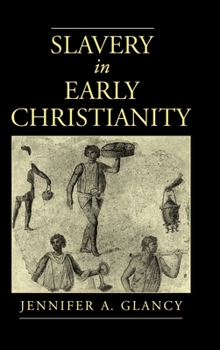
Slavery in Early Christianity

Select Format
Select Condition 
Book Overview
Slavery was widespread throughout the Mediterranean lands where Christianity was born and developed. Though Christians were both slaves and slaveholders, there has been surprisingly little study of what early Christians thought about the realities of slavery. How did they reconcile slavery with the Gospel teachings of brotherhood and charity? Slaves were considered the sexual property of their owners: what was the status within the Church of enslaved women and young male slaves who were their owners' sexual playthings? Is there any reason to believe that Christians shied away from the use of corporal punishments so common among ancient slave owners? Jennifer A. Glancy brings a multilayered approach to these and many other issues, offering a comprehensive re-examination of the evidence pertaining to slavery in early Christianity. Drawing on a wide variety of sources, Glancy situates early Christian slavery in its broader cultural setting. She argues that scholars have consistently underestimated the pervasive impact of slavery on the institutional structures, ideologies, and practices of the early churches and of individual Christians. The churches, she shows, grew to maturity with the assumption that slaveholding was the norm, and welcomed both slaves and slaveholders as members. Glancy draws attention to the importance of the body in the thought and practice of ancient slavery. To be a slave was to be a body subject to coercion and violation, with no rights to corporeal integrity or privacy. Even early Christians who held that true slavery was spiritual in nature relied, ultimately, on bodily metaphors to express this. Slavery, Glancy demonstrates, was an essential feature of both the physical and metaphysical worlds of early Christianity. The first book devoted to the early Christian ideology and practice of slavery, this work sheds new light on the world of the ancient Mediterranean and on the development of the early Church.
Format:Hardcover
Language:English
ISBN:0195136098
ISBN13:9780195136098
Release Date:March 2002
Publisher:Oxford University Press
Length:224 Pages
Weight:1.26 lbs.
Dimensions:0.9" x 6.4" x 9.6"
Customer Reviews
2 ratings
A welcome addition to both university library and private religious studies collections.
Published by Thriftbooks.com User , 19 years ago
Jennifer A. Glancy (Professor of Religious Studies, LeMoyne College) presents Slavery in Early Christianity, a highly scholarly examination of the prevalence of slaves and slaveholders among early Christians, particularly in the Roman Empire. Chapters scrutinize how the social histories of emerging Christian churches had their rhetoric affected by the influence of slavery, the life experiences of slaves and what it meant to be a slave in the first Christian centuries. Of particular interest is the figure of the slave in the sayings of Jesus Christ, an aspect examined at length in historical and social as well as a religious context. A welcome addition to both university library and private religious studies collections.
A noteworthy contribution, superbly written, well researched
Published by Thriftbooks.com User , 24 years ago
Dr. Glancy has filled a void in the realm of Classical/religious studies in addressing the issue of slavery in the ancient Christian world. It is a readable, superbly researched text. Every college and university library should have this volume in the collection.
Copyright © 2026 Thriftbooks.com Terms of Use
| Privacy Policy | Do Not
Sell/Share My Personal Information | Cookie Policy | Cookie Preferences | Accessibility Statement
ThriftBooks® and the ThriftBooks® logo are registered trademarks of Thrift Books Global, LLC
ThriftBooks® and the ThriftBooks® logo are registered trademarks of Thrift Books Global, LLC
