


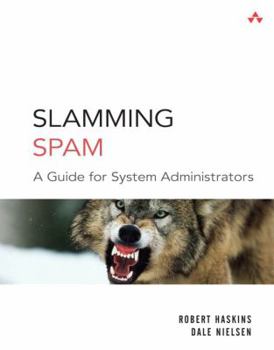
Slamming Spam: A Guide for System Administrators


Offers sys admins vital help in managing spam and keeping its load off their networks. This description may be from another edition of this product.
Format:Paperback
Language:English
ISBN:0131467166
ISBN13:9780131467163
Release Date:January 2005
Publisher:Addison-Wesley Professional
Length:396 Pages
Weight:0.45 lbs.
Dimensions:0.8" x 7.0" x 9.2"
Customer Reviews
5 ratings
Good resource for messaging systems administrators
Published by Thriftbooks.com User , 20 years ago
Be it inane e-mails with topics such as "retention bobble cicada emanuel," attempts to pitch 21st century snake oil, or incessant pleas to refinance your mortgage or find a date online, we've all received our share of spam. And as antispam software develops, mass marketers get ever more crafty in defeating these programs. Spam is truly overwhelming today's workplaces, and systems administrators are in dire need of effective solutions. One place to turn is Slamming Spam, a systems administrator's and messaging administrator's guide to reducing spam. With its hands-on, high-level approach for detecting, managing, and eliminating spam, the book is not for beginners. Readers are expected to be comfortable with UNIX and Windows system administration and be familiar with core concepts of messaging and messaging protocols. Thankfully, the authors don't delay in providing helpful information. By chapter two, the book is already in the solutions phase of how to harden a system against spam. Besides covering SpamAssassin, a popular open-source antispam tool, the book shows how to protect messaging systems, such as Microsoft Exchange and Lotus Domino, and messaging clients including Outlook Express and Mozilla Messenger. Alternative solutions to junk e-mail are provided as well, including Sender Policy Framework (which identifies spoofed mail) and DSPAM (an open-source statistics-based spam filter), as well as commercial solutions. Whitelists and blacklists, DNS black-hole services, header checking, and other antispam niceties are explained as well. The result is a book that will help any organization substantially reduce its spam intake.
Nice Read
Published by Thriftbooks.com User , 21 years ago
I was naive to believe that stricter laws would decrease spam. Now I think that while stricter laws may not decrease the amount of spam that spammers send, they can certainly help filters to decrease the amount of spam that recipients actually see. The Bayes theorem used to fight spam by most of the spam filters of the day finds its roots in 1763 when a year after his death the work of Thomas Bayes was published. The development of probability theory in the early 18th century arose to answer questions in gambling, and to underpin the new and related ideas of insurance. A problem arose, known as the question of inverse probability: the mathematicians of the time knew how to find the probability that, say, 4 people aged 50 die in a given year out of a sample of 60 if the probability of any one of them dying was known. But they did not know how to find the probability of one 50-year old dying based on the observation that 4 had died out of 60. Like many educated men of his time, Bayes was both a clergyman and an amateur scientist/mathematician. His solution, known as Bayes' theorem, underlies, and gave its name to, the modern Bayesian approach to the analysis of all kinds of data. A nice read to understand the ongoing battle against spam. Niloufer Tamboly, CISSP
DALE NIELSEN Kicks it "Old School"
Published by Thriftbooks.com User , 21 years ago
This book is written by and for bare-metal sysadmins! I used to work with Dale and I vividly remember him taking about having to use some system debugger to setup NFS on a very earlier version of Sunos. It was cool (as Dale recounted) because you were right down on the "bare metal" flipping bits to make something work. No stupid UI, not even a command line - just the bare metal! Joe E O
More practical than theoretical...
Published by Thriftbooks.com User , 21 years ago
Another book to add to your spam prevention arsenal... Slamming Spam - A Guide For System Administrators by Robert Haskins and Dale Nielsen (Addison-Wesley). Chapter List: Introduction; Procmail; SpamAssassin; Native MTA Anti-Spam Features; SMTP AUTH and STARTTLS; Distributed Checksum Filtering; Introduction to Bayesian Filtering; Bayesian Filtering; Email Client Filtering; Microsoft Exchange; Lotus Domino and Lotus Notes; Sender Verification; Sender Policy Framework; Reporting Spam; Default SpamAssassin Ruleset; SpamAssassin Command Line Interface Reference; SpamAssassin Configuration File; DSPAM; References; Index I'll say right up front that this book gets bonus points for covering Notes/Domino, as most books ignore the fact that it is the leading corporate messaging system. :-) The book doesn't focus much on theoretical discussions of spam, what it is, and why it's bad. It just digs into hands-on scenarios using various spam-prevention options on different system platforms. They cover platforms such as Sendmail, Postfix, qmail, Microsoft Exchange, and Notes/Domino, so somewhere in that list you should find your mail system. Being the book is more practical in nature, it should probably be coupled with another title that's more general in nature so that you gain a complete understanding of the subject coupled with how spammers work. But for someone who's already covered those basics and is now ready for implementation, this is a good addition to the bookshelf.
Good book for admins
Published by Thriftbooks.com User , 21 years ago
When opening the book, I was convinced that spam doesn't really deserve a book. However, I enjoyed scanning through this "Slamming Spam" and picked up an idea or two from it. I liked the chapters on Bayesian methods, and I think that this book contains one of the clearest explanations on how they work and how to make them work for you. Overall, the book is very practical and will be great for people configuring mails servers for spam-fighting on a daily basis. However, this is not an in-depth review, since I am not tasked with fighting spam (and SpamAssassin does a fine job on my mail account). Anton Chuvakin, Ph.D., GCIA, GCIH, GCFA is a Security Strategist with a major security company. He is an author of the book "Security Warrior" and a contributor to "Know Your Enemy II". In his spare time, he maintains his security portal info-secure.org
Copyright © 2026 Thriftbooks.com
Terms of Use | Privacy Policy | Do Not Sell/Share My Personal Information | Cookie Notice | Cookie Preferences | Accessibility Statement
ThriftBooks ® and the ThriftBooks ® logo are registered trademarks of Thrift Books Global, LLC
ThriftBooks ® and the ThriftBooks ® logo are registered trademarks of Thrift Books Global, LLC
