


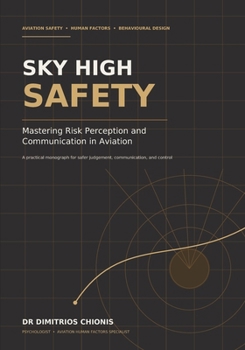
SKY HIGH SAFETY: Mastering Risk Perception and Communication in Aviation

Why do capable aviation professionals miss weak signals, soften warnings, or continue when conditions have changed?
Aviation safety depends on technology, procedures, and professional expertise. Yet every safeguard still depends on someone who must notice a cue, understand its meaning, communicate it clearly, and act in time.
Sky High Safety explains how risk travels through people, teams, and organisations. It connects risk perception, risk communication, human factors, and behaviour change within one practical framework.
Drawing on doctoral research, studies reviewed by academic peers, 140 aviation safety reports, and interviews with aviation professionals, Dr Dimitrios Chionis examines why critical information is sometimes missed, misunderstood, delayed, or stripped of urgency.
Readers will learn how to:
- recognise the path from a weak signal to effective action
- identify psychological, organisational, and environmental influences on risk perception
- communicate uncertainty without creating confusion or false reassurance
- understand why training alone often fails to change behaviour
- design interventions around capability, opportunity, and motivation
- apply the six stage SARIM operating model
SARIM provides a structured route from signal detection to behavioural control and organisational learning. It works alongside an existing Safety Management System. It does not replace formal risk assessment, investigation, or professional judgement.
Sky High Safety is written for aviation leaders, safety managers, investigators, human factors specialists, trainers, and operational professionals. It is for readers who must turn evidence into clearer decisions, stronger communication, and safer action.
Customer Reviews
ThriftBooks ® and the ThriftBooks ® logo are registered trademarks of Thrift Books Global, LLC
