


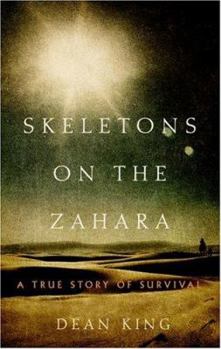
Skeletons on the Zahara: A True Story of Survival


Select Format
Select Condition 
Book Overview
A crucial, forgotten chapter of American history--immortalized in a survivor's firsthand account that became one of the bestselling books in 19th-century America and influenced Abraham Lincoln's thoughts on slavery--is brilliantly retold for a new generation.
Format:Hardcover
Language:English
ISBN:0316835145
ISBN13:9780316835145
Release Date:March 2004
Publisher:Little, Brown and Company
Length:320 Pages
Weight:1.30 lbs.
Dimensions:9.5" x 1.1" x 6.3"
Age Range:13 years and up
Customer Reviews
4 ratings
I read this book years ago .... "Sands of the Zahara" .... title is now different "Skeletons on the
Published by Jean D , 1 month ago
I remember it being titled as "Sands of the Zahara" the spelling Zahara had me remembering this book from years past. It's a real good read .... I just ordered it I want to read it again .... !!!!
Unbelievably Fascinating
Published by Thriftbooks.com User , 22 years ago
I cannot praise this book enough for anyone who is remotely interested in survival stories. For the several days I was reading it, I had to talk about it to anyone who crossed my path, and the subjects usually included dehydration, starvation, burning skin and other intense forms of suffering. I was blown away by the amount of damage the human body and spirit can take and yet still continue on. It was truly hard to believe. What I really found interesting was how the author took the time to explain the scientific aspects of how dehydration works on the body, the stages that kick in, etc. I also learned that camels are prized for much more than just their ability to go a long time without water. Mr. King packs the book full of fascinating information, a lot of which he says still holds true for Arabs roaming the desert today.
Real survivors
Published by Thriftbooks.com User , 22 years ago
In 1815 a New England merchant brig foundered in rocky seas off North Africa. Its crew survived though perhaps they later wished they hadn't.In the first days, hostile nomads drove them to escape back to the sea in a small boat with a broken oar only to suffer such dehydration and starvation that even enslavement by the dreaded nomads seemed preferable - until it happened.After a slow, thoughtful start laying out the background of the men and the voyage, Dean's story of the crew's ordeal reads like a runaway suspense thriller with torture. And it's well written and chock full of information you didn't know you needed - the camel, for instance, is an astonishing physical specimen, a creature with a face built for sandstorms; an animal that doesn't sweat or pant, but stores its heat for the cold nights when it becomes a kind of living stove.Dean's book is based largely on two firsthand accounts - one by ship's captain James Riley, and another by crewman Archibald Robbins. Dean also retraced much of Riley's trek, and his selected bibliography is lengthy.Near death, the crew puts back into shore and, unable to find water, throws themselves on the mercy of the first nomads they encounter. The men are immediately stripped naked, then parceled out as slaves - after a bloody and protracted fight among the desert dwellers. Their first guzzle of water and sour camel's milk rips through their intestines, a cycle that is to be repeated throughout their ordeal.Separated, sunburned, depleted, still naked and unable to keep up, the men are put on camels. "It is no coincidence that a camel's gait is called a `rack'." Blood was soon dripping from chafed thighs and calves.The ordeal goes from horror to worse. The nomads themselves often have nothing to eat or drink; bloody encounters and thievery are common. The sailors are worth rather less than a lame camel. Less than a good blanket, in fact.The physical suffering is enough to make you marvel at their will to live, but Dean also conveys the helplessness of slavery. Purposely dehumanized, their lives are entirely subject to commerce or whim. Riley, a man of his time who, Dean speculates, may have planned on acquiring a slave cargo, became a fervent abolitionist on his return.Riley comes alive on the page as a man of indomitable will, who takes his responsibilities to his men to heart. Eventually he strikes a bargain with an Arab trader, a promise based on a lie and a gamble that develops into something more personal, if precarious. The denouement is a protracted drama of danger, diplomacy and daring that will keep you on the edge of your seat.Riley's book was a best selling sensation, which remained in print long after his death, so a certain amount of skepticism is necessary. But the later events of his life bear out his energy, strength and charisma. Dean's ("Patrick O'Brian: A Life Revealed") stirring account, fleshed out with information about the desert, the people, their history and the cultural importance
A Gritty Story that Will Make a Super Movie Someday
Published by Thriftbooks.com User , 22 years ago
In 1815 Captain James Riley and the crew of the United States merchant ship Commerce set sail from Connecticut for Gibraltar. Two months later they were shipwrecked near Cape Bojador, off the coast of Northern Africa, captured by Sahrawi Arabs, sold into slavery and dragged eight hundred miles across the hot and hostile Sahara Desert. Along the way they were fed meager rations and pressed into hard labor as the faced barbarism, murder, starvation, dehydration, scorpions, plagues of locusts, sandstorms, hostile enemies and death.Also along the way they discovered secret oases and ancient cities as Captain Riley forged a surprising bond with a Muslim trader. They were forced to become allies in order to survive, even as Riley planed on betraying the trader in order to save his men.Dean tells a disturbing, but true tale of endureance that finally came to an end when an Arab tribal leader brought the exhausted and emaciated men to the provincial trading post of Swearah where the British paid the ransom for their freedom.This read like a pulse racing thriller. I know I couldn't put it down and I can't recommend it highly enough.Sophie Cacique Gaul
Copyright © 2026 Thriftbooks.com
Terms of Use | Privacy Policy | Do Not Sell/Share My Personal Information | Cookie Notice | Cookie Preferences | Accessibility Statement
ThriftBooks ® and the ThriftBooks ® logo are registered trademarks of Thrift Books Global, LLC
ThriftBooks ® and the ThriftBooks ® logo are registered trademarks of Thrift Books Global, LLC
