


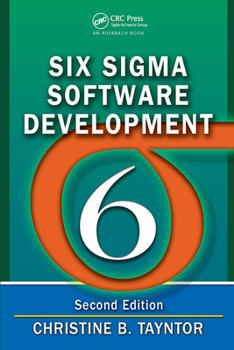
Six Sigma Software Development

Even though Six Sigma programs have successfully been implemented in practice, many IT departments remain skeptical of the process or are unaware of how the tools can be used to improve system development. Removing the mystique surrounding this technique, Six Sigma Software Development, Second Edition demonstrates how Six Sigma tools and concepts can be used to enhance the system development process. Revised and updated, this second edition clearly explains Six Sigma concepts and their application, maps Six Sigma concepts and tools to all aspects of system development, and proposes the use of Six Sigma tools to evaluate and improve the overall performance of the IT department. In addition to classic Six Sigma, the book introduces Design for Six Sigma (DFSS) and illustrates when and how its tools and techniques can be used to increase the robustness and reliability of a new system. It also shows how the judicious application of lean tools can reduce the complexity of IT processes, thus shortening the time needed to translate customer requirements into completed systems and increasing customer satisfaction.
Format:Paperback
Language:English
ISBN:1420044265
ISBN13:9781420044263
Release Date:March 2007
Publisher:Auerbach Publications
Length:486 Pages
Weight:1.56 lbs.
Dimensions:1.0" x 6.0" x 8.6"
Customer Reviews
4 ratings
Guide to lifecycle adaptation for Six Sigma
Published by Thriftbooks.com User , 22 years ago
Tayntor does an excellent job of laying a foundation for Six Sigma understanding, and of mapping that foundation to applications across the traditional SDLC lifecycle. The first third of the book is devoted to a general explanation of the Six Sigma DMAIC process and its related tools. Newcomers to Six Sigma will find these opening chapters helpful to gain an understanding of Six Sigma improvement. The middle third of this book is devoted to a phase by phase overview of Six Sigma tool applications in the traditional development lifecycle. The final third offers insights into less traditonal lifecycles, project types, and organizational change models. Tayntor writes to the novice audience, and deals with lifecycle issues more than technical issues. Readers from less mature organizations, often relying on traditional lifecycle models, will directly adapt and use her materials. More mature audiences will readily adapt her traditional phase mapping to the higher level challenges faced by organizations adopting non-traditional process and software engineering disciplines. Six Sigma Software Development belongs on every information systems bookself.
Great book on the application of Six Sigma
Published by Thriftbooks.com User , 22 years ago
Well written - easy to understand some very powerful concepts - definitely a great first read if you are interested in how to apply Six Sigma to software or any other business application.
Finally!
Published by Thriftbooks.com User , 22 years ago
Finally! A book on Six Sigma especially tailored to software developers--something that's been sorely lacking. And it's a good one. Very comprehensive and well written.
Much needed book for the SW engineering community
Published by Thriftbooks.com User , 23 years ago
There are a number of books about measuring the software process or employing applied statistics in the software engineering environment, but this is the first one that solely addresses 6-Sigma as it applies to software development.What I like is that, unlike other 6-sigma books that address manufacturing or business processes, this one does not come across as evangelistic or prescriptive. Instead Ms. Tayntor explains what 6-sigma is and how it can be effectively applied to software development. The first two chapters thoroughly cover the basics and benefits of 6-Sigma to provide a foundation for the rest of the book. My only complaint about the opening chapters is they cover the DMAIC (Define, Measure, Analyze, Improve, Control) framework, which assumes that processes exist, but need to be improved. In my opinion, since this book is introducing 6-Sigma the focus should have been on DMADV (Define, Measure, Analyze, Design, Verify). However, this is a fine point and does not substantially detract from this excellent book.After laying the foundation, the book then covers how 6-Sigma applies to different development life cycle approaches (waterfall, rapid development, prototyping, etc.), and also how it applies to legacy operations. I especially liked the latter because she addresses change control, maintenance and support functions - important, but often overlooked topics. The book also discusses topics outside of the normal realm of software development, such as packaged software, outsourcing, and IT operations. In addition, the appendices are especially valuable because they cover how to map functional processes, conduct a failure mode and effects analysis, and rank priorities.This book is an important resource to the software engineering community, and is especially valuable to CMM level 4 and 5 organizations. Most importantly, it brings techniques that have been amply proven in the manufacturing and service sectors to software engineering and shows how they can be realistically applied.
Copyright © 2026 Thriftbooks.com Terms of Use
| Privacy Policy | Do Not
Sell/Share My Personal Information | Cookie Policy | Cookie Preferences | Accessibility Statement
ThriftBooks® and the ThriftBooks® logo are registered trademarks of Thrift Books Global, LLC
ThriftBooks® and the ThriftBooks® logo are registered trademarks of Thrift Books Global, LLC
