


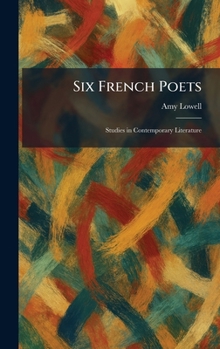
Six French Poets: Studies in Contemporary Literature

Select Format
Select Condition 
Book Overview
"Six French Poets - Studies in Contemporary Literature" is an insightful collection of critical essays by the celebrated American poet Amy Lowell. Through this work, Lowell offers a comprehensive exploration of the influential figures who shaped the landscape of modern French verse at the turn of the twentieth century. The study focuses on six key writers: Emile Verhaeren, Albert Samain, Remy de Gourmont, Henri de R gnier, Francis Jammes, and Paul Fort.
Lowell provides detailed biographical sketches and astute literary analysis, guiding readers through the shifts from Symbolism to the burgeoning modernist movements in France. By including translated passages and expert commentary, she renders the complex beauty of French poetry accessible to a broader English-speaking audience. This work serves as both a historical record of a transformative period in literature and a testament to Lowell's own deep engagement with the craft of poetry. "Six French Poets - Studies in Contemporary Literature" is an essential volume for scholars of European literature, students of poetic theory, and admirers of the Imagist movement seeking to understand the cross-cultural influences that defined an era.
This work has been selected by scholars as being culturally important, and is part of the knowledge base of civilization as we know it. This work was reproduced from the original artifact, and remains as true to the original work as possible. Therefore, you may see the original copyright references, library stamps (as most of these works have been housed in our most important libraries around the world), and other notations in the work.
This work is in the public domain in the United States of America, and possibly other nations. Within the United States, you may freely copy and distribute this work, as no entity (individual or corporate) has a copyright on the body of the work.
As a reproduction of a historical artifact, this work may contain missing or blurred pages, poor pictures, errant marks, etc. Scholars believe, and we concur, that this work is important enough to be preserved, reproduced, and made generally available to the public. We appreciate your support of the preservation process, and thank you for being an important part of keeping this knowledge alive and relevant.
Customer Reviews
ThriftBooks® and the ThriftBooks® logo are registered trademarks of Thrift Books Global, LLC
