


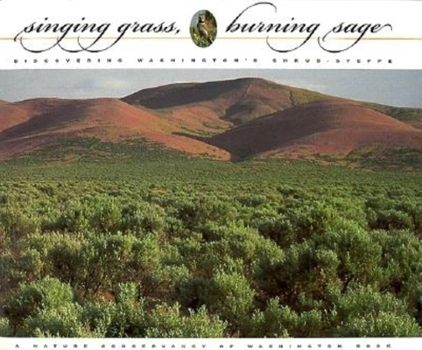
Singing Grass, Burning Sage


This book offers an intriguing introduction to Washington's vast arid lands dominated by fragrant sagebrush, lush coulees, and unique desert creatures and plants.
Format:Paperback
Language:English
ISBN:1558684786
ISBN13:9781558684782
Release Date:June 2003
Publisher:West Margin Press
Length:120 Pages
Weight:1.40 lbs.
Dimensions:9.5" x 0.5" x 10.7"
Customer Reviews
1 rating
Singing Grass, Burning Sage
Published by Thriftbooks.com User , 19 years ago
This is another of the very fine books featuring the pen of Jack Nesbit. Washington State east of the Cascade Mountains is a land in the midst of change. Known as the Columbian Plateau, the land was originally arid shrub-steppe. Irrigated with water from aquifers and dams on the Columbia River, it becomes extremely productive agricultural land. The amount of land developed has reached the critical point where the very nature of the land; beauty, flora, fauna, spirit; is in danger of spiraling out of existence. Perhaps it is not too late. With insightful management of what has not yet changed and careful stewardship of what has changed, the nature of the shrub-steppe on the Columbia Plateau may not be lost forever. Published by the Nature Conservancy of Washington, this book describes what the shrub steppe is like, what changes are occurring, and what might yet be done to preserve some of its natural character. The book is a combination of gorgeous photos and easily read text. The organization provides the area's history; followed by sections on the humans, plants, insects & arachnids, fish, amphibians & reptiles, mammals, and birds that have inhabited the area both past and present. The closing chapter addresses the good or bad that the future can hold, depending on what action we take in the near future. For example, the United States controls a large domain known as the Hanford Nuclear Reservation and is at the point of disposing of much of the property. The majority is much like it was before the time of Lewis and Clark. If the property passes into private ownership, the changes likely to occur would greatly reduce the chances of retaining a viable example of the shrub-steppe habitat for enjoyment by future generations and ourselves. Two decisions made during the book's publication seem to make little sense. The type is too small for some readers. Since it is double spaced, that doesn't seem necessary. My other complaint is quoting sections of the text verbatim as sidebars alongside the text. Some of the quotes in the sidebars are from other writers and that adds to the book. The duplications from the text do not. Although wonderful, some of the text in this book is not up to the best writing Nesbit has produced. He had to cover too much in too few words. He worked the content masterfully and produced very readable copy throughout. The flow and lyricism suffered slightly. However, just to prove Nesbit's genius; the section on birds is nature-writing at its very best. Consider the opening paragraph: "It is impossible to travel through any part of the Columbia Plateau without sensing the flick and soar of many wings. The expansive shape of the land provides a magnetically attractive space in which to fly. Fractured basalt pinnacles serve as peerless lookout roosts, while long low ridges and interconnected coulees offer navigation guides for migrants. Infinite nicks, caves, pothole lakes, evergreen shrubs, and tre
Copyright © 2026 Thriftbooks.com
Terms of Use | Privacy Policy | Do Not Sell/Share My Personal Information | Cookie Policy | Cookie Preferences | Accessibility Statement
ThriftBooks ® and the ThriftBooks ® logo are registered trademarks of Thrift Books Global, LLC
ThriftBooks ® and the ThriftBooks ® logo are registered trademarks of Thrift Books Global, LLC
