


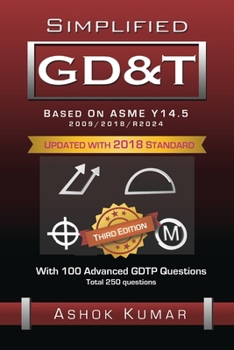
Simplified GD&T: Based on ASME-Y 14.5-2009
No Customer Reviews

Select Format
Select Condition 
Book Overview
Dear Readers, While I am excited to present the THIRD EDITION of the book, primarily to include the updates from 2018 standard (reaffirmed in R2024) and to add 100 advanced questions to help GDTP certificate aspirants, I also want to take this opportunity to express my gratitude towards the readers from the USA (highest selling marketplace), the UK, Germany, France, Spain, Netherlands, Sweden, Japan, Canada, Australia, Brazil, Mexico, and India to keep me motivated to write yet another edition of the book. What to expect from this book This books is primarily written for mechanical engineers aspiring to become a world class designer. GD&T is not only one of the key contributor towards global manufacturing but it also provides multiple options to a designer to ensure proper part functioning and providing only necessary tolerances to reduce the time & cost of manufacturing. This book will take the reader through an exciting journey of learning new mechanical engineering language, namely, Geometric Dimensioning and Tolerancing (GD&T). It is a functional language to define and communicate geometric tolerances (allowable variations) applicable to geometries (also called features) of mechanical parts and assemblies. The purpose of this book is to learn (read and write) this language. Below are few of the highlights of the book: This book covers 2009 and 2018 (R2024) standards of ASME Y14.5.250 questions are provided in the book, indcluding 100 fundamental based questions, 50 design calculations based questions, and 100 advanced questions (added in the THIRD EDITION) to help the GDTP (Y14.5) certificate aspirants.All related updates from 2018 standard are taken, and also highlighted throughout the book, specially for the GDTP certificate aspirants preparing on the basis of 2009 standard.Fundamental concepts of hole and shaft basis systems, basic/nominal size, limit, tolerance, actual size, deviation, allowance, and related technical terms.Understanding mechanical features, a feature of size (FOS) and feature material condition (MMC/LMC/RFS), Datum, Datum feature, Datum Reference Frame, the degree of freedom, datum target, and datum simulators.Fourteen feature controls tolerances of GD&T, practical application of each tolerance, the impact of MMC/LMC/RFS, understanding bonus tolerance, and writing the GD&T in feature control frame (FCF).Advanced concepts of boundary and envelope, MMB, LMB, RFB, virtual condition, resultant condition, unrelated and related actual mating envelopes.16 frequently used modifiers, including 2 new extremely useful modifiers "Dynamic Profile" and "From-To" added in 2018 standard.Appendix section includes the concept of ISO-286 and IT grades, and also the industry best practices being used for dimensional tolerancingWhile covering the core GD&T concepts, couple of designing process and analysis of industrial application examples have also been included to provide holistic knowledge for practical purposes. I wish tremendous success to the readers - Ashok PS: About the journey of writing this book:
I was excited to find a new evolving language in the industry. To find out the ground reality of usage of GD&T, I visited industries and educational institutes. Almost everywhere, a sense of difficulty to understand the new concept was found. To bridge this gap, he collaborated with industry experts, educators, and professionals to gather real-world applications and challenges. After incorporating honest feedback from design heads and academic leaders on an initial draft, he created this textbook. It is a collective effort designed to offer practical, easy-to-grasp insights. Readers are encouraged to leverage this shared expertise to master and apply GD&T effectively in their careers.
I was excited to find a new evolving language in the industry. To find out the ground reality of usage of GD&T, I visited industries and educational institutes. Almost everywhere, a sense of difficulty to understand the new concept was found. To bridge this gap, he collaborated with industry experts, educators, and professionals to gather real-world applications and challenges. After incorporating honest feedback from design heads and academic leaders on an initial draft, he created this textbook. It is a collective effort designed to offer practical, easy-to-grasp insights. Readers are encouraged to leverage this shared expertise to master and apply GD&T effectively in their careers.
Format:Paperback
Language:English
ISBN:1980948712
ISBN13:9781980948711
Release Date:April 2018
Publisher:Independently Published
Length:180 Pages
Weight:0.97 lbs.
Dimensions:0.5" x 6.0" x 9.0"
Customer Reviews
0 rating
Copyright © 2026 Thriftbooks.com Terms of Use
| Privacy Policy | Do Not
Sell/Share My Personal Information | Cookie Policy | Cookie Preferences | Accessibility Statement
ThriftBooks® and the ThriftBooks® logo are registered trademarks of Thrift Books Global, LLC
ThriftBooks® and the ThriftBooks® logo are registered trademarks of Thrift Books Global, LLC
