


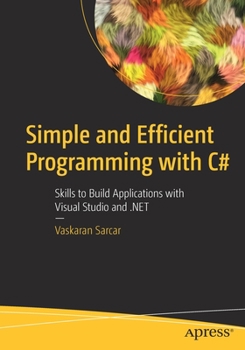
Simple and Efficient Programming with C#: Skills to Build Applications with Visual Studio and .Net

Chapter Goal: To show you the proper use of comments. It also discusses the side-effects of bad/redundant comments.
No of pages: 5-10+
Chapter 2: Use PolymorphismChapter Goal: To show why a polymorphic code can perform better.
No of pages 5-10+
Sub - Topics
2.1 Initial Program: Demo 1
2.2 Output and Analysis
2.3 Making efficient programs: Demo 2
2.4 Analysis
2.5 Conclusion
Chapter 3: Abstract Class, or Interface?Chapter Goal: In this chapter, we do not compare the basic differences between an abstract class or an interface. Instead, we discuss the code segments where you can use either of them, but the compiler does not raise any issue. Then we will analyze how to write efficient code using both these techniques for some specific scenarios.
No of pages: 10-15+
Chapter 4: Static Method or Instance Method?Chapter Goal: This chapter shows how to decide between a static method and an instance method. It shows the answer with supporting code examples.
No of pages: 5-10+
Part II Important Principles
Chapter 5: The SOLID Principle(s)
Chapter Goal: This chapter explains the Single Responsibility Principle( SRP), Open/Closed Principle (OCP), Liscov Substitution Principle (LSP), Interface Segregation Principle (ISP), and Dependency Inversion Principle (DIP) principles (with and without ) with code examples.
No of pages 50+
Chapter Goal: In this chapter, you learn about the DRY principle and its importance by building applications in C#. DRY stands for DON'T REPEAT YOURSELF and is a basic principle of software development, aimed to reducing repetition of information.
No of pages: 10-15+
Chapter 7: Separate Changeable Code Using Factories
Chapter Goal: This chapter shows the common use of factories to separate the varying code from its opposite.
No of pages: 10-20+
Chapter 8: Add Features Using WrappersChapter Goal: This chapter shows the alternative of inheritance using object composition and wrappers.
No of pages: 10-20+
Chapter 9: Efficient Templates using HooksChapter Goal: This chapter shows the use of hooks inside a template method to shorten your code.
No of pages: 10-15+
Chapter 10: Simplify Complex Systems using FacadesChapter Goal: This chapter shows the use of facades to simplify a complex system.
No of pages: 10-15+
Part IV The Final TalksChapter 11: Apply Design Patterns
Chapter Goal: This chapter discusses the uses of design patterns and shows which patterns are already implemented in this book on different topics. It also discusses the misuse of patterns.
No of pages: 5-10+
Sub - Topics NA
Chapter 12: The Road AheadChapter Goal: It discusses some other techniques in brief.
No of pages: 5-10+
Sub - Topics NA
Customer Reviews
ThriftBooks ® and the ThriftBooks ® logo are registered trademarks of Thrift Books Global, LLC
