


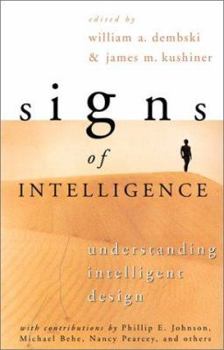
Signs of Intelligence: Understanding Intelligent Design

Select Format
Select Condition 
Book Overview
Fourteen brief and accessible essays by key players in the intelligent design movement This description may be from another edition of this product.
Format:Paperback
Language:English
ISBN:1587430045
ISBN13:9781587430046
Release Date:March 2001
Publisher:Brazos Press
Length:224 Pages
Weight:0.84 lbs.
Dimensions:9.0" x 0.5" x 6.0"
Age Range:18 years and up
Grade Range:Postsecondary and higher
Customer Reviews
5 ratings
Hateful Reviewers
Published by Thriftbooks.com User , 20 years ago
Have you ever noticed that when evolutionists comment on ID books they are almost always hatefull, angry, and rude? (No, not always. I know.) ID proponents rarely sugar-coat a responce to the evolutionists, but I have rarely ever (if at all) read a mean, vengeful review by an ID proponent. I'm sure they exist so don't bother pulling out your quotes. Just notice how vicious the anti-ID people can be and ask yourself, if one person has to resort to name calling, sarcasm, and insults to put down another person's position, what does that say about the strength of the one person's argument?
Diverse Scholars Explain the Evidence for Intelligent Design in the Nature
Published by Thriftbooks.com User , 20 years ago
Signs of Intelligence is a collection of essays from various scholars of the intelligent design movement who are explaining the precise meaning of the scientific theory of intelligent design. When the NCSE reviewed this book, they called it "aimless." A more accurate description would have been "threatening a wide variety of disciplines behind the curtain of Darwinism." Mathematician and philosopher William Dembski opens the book by clearing up a common misconception by explaining that intelligent design does not necessarily mean "optimal design" (Also, see The Privileged Planet for a discussion of the concept of constrained optimization). Law professor Phillip Johnson proposes that science has adopted an inherently "materialist" model where explanations can never be non-material causes. Alternatively, Johnson suggests that science adopt a strictly "empirical" model, which uses the scientific method of hypothesis and experimentation but does not limit its answers to naturalistic causes. Michael Behe proposes some novel examples of irreducible complexity. Namely, the cell's protein transport system contains a number of macromolecules, all of which are necessarily simply to get a protein to its correct destination in the cell. This irreducibly complex system reveals deeper levels of complexity in protein transport and assemblage, beyond mere proper irreducible complexity in protein functionality. Similarly, Stephen Meyer argues that the specified complexity in DNA, combined with the inability of natural explanation to explain the origin of life, imply that design is the best explanation. Meyer explains that this is not a "God-of-the-gaps" type argument because we have much observational experience that intelligent agents exclusively produce such forms of encoded specified complex information. Other essays include Jonathan Wells' observations that more than simply the genetic code is required to account for life, a conclusion which is eschewed by the dogma of Neo-Darwinism; Paul Nelson's discussion of natural selection as a tautology with weak explanatory power; and Robert Dehaan and John Weister's arguments that the "top-down" pattern of the appearance of biological diversity implies that design took place during the Cambrian explosion and in the history of life as a whole. Rather than being aimless, this book shows that design arguments are spreading into a variety disciplines and subdisciplines. This book provides plenty of essays by leading design scholars as to why empirical evidence should trump naturalistic philosophy in a diverse set of scientific fields.
Don't be misled by "poor" reviews
Published by Thriftbooks.com User , 23 years ago
If you are a free thinker, this book is an outstanding introduction to ID. Most of the poor reviews are more of a reflection of the personal biases of the reviewers than the book they are reviewing.In fact, at least two reviewers incorrectly assert that this book attempts to discredit modern molecular biology. This book does nothing of the sort. In fact, this book presents a number of well-reasoned arguments that neo-evolutionary theory is inconsistent with some contemporary observations of molecular biology, in no way do the authors assert to discredit molecular biology.If you are open minded and willing to confront science honestly then you will find this book interesting and intelligent, even if in the final analysis you do not agree with its conclusions.
Book should be read before being reviewed...
Published by Thriftbooks.com User , 24 years ago
A previous reviewer mused:"this book makes no sense, and cannot answer the fundamental logical inconsistency of the creationist argument. if coherence in structure in design presupposes a creator, who then created the structure of this creator? there then must have been a higher upper creator, who in turn must have had a creator, ad infinitum. if you are a creationist you will love this book, otherwise it is a waste of time." Evidently, the book was not read. Dr. Dembski (editor) and the contributing works detail and critique the logical and structrual evidence of design and information extant in the universe.The response of the "reviewer" quoted above expresses [a] that the book was not read, else why not address at least *some* of its content (or essential thesis), and [b] he or she was simply expressing their ignorance of the issues and of basic theology.Modern science is in essential agreement that the universe has not always existed--it had a *beginning*, even time itself is said to have come "into being" at some specific point in the past.Theology does not argue that God--the "Intelligent Designer"--merely preceded the universe, but that the Intelligent Designer is transcendent to it and is eternal. As such, his question is a non sequitor; it is illogical and pointless to ask, "who made this eternal uncreated intelligent being?"An eternal, uncreated designer does not have a beginning or a creator. The "reviewer" is confused and confusing the categories of a infinite necessary being and a finite contigent being. This is a very low level, hack objection, but, sadly, we do still hear it from time to time.Now, if the argument of theism were that the Intelligent Designer merely preceeded the universe, then there would be legitimate complaint--but no such thesis is postulated by theism.So, we do have, by concensus of empirical science, a universe that did not always exist and came into existence sometime in the finite past. Theism postulates a transcendent, eternal intelligent Being that has always existed--indeed, that even created time itself and exists outside of the space-time universe.Read the book for yourself. And if you want to understand basic issues of theism, get a good systematic theology.
Excellent Introduction to ID
Published by Thriftbooks.com User , 25 years ago
I'm not a scientist, but Intelligent Design (ID) has caught my attention. There was the article in the Wall Street Journal about the tenured full professor at San Frans. State U. who was pulled mid-semester from teaching the biology intro. course because he spent a single session presenting views such as ID that challenged the reigning Neo-Darwinian dogma. There was the fury I heard on NPR over Phillip Johnson's *Darwin on Trial.* There was Dembski's dismissal from his post at Baylor U. for inviting non-Darwinian speakers to a academic forum on the origins of life.Why were so many folks so emotionally opposed to a handful of scientists who are finding compelling eveidence for God's fingerprint in nature?I've now read a few of these ID books now and am very impressed. This latest work is a very fine introduction. The contributors are all top-drawer thinkers (Dembksi has a Ph.D. from U. of Chicago in Math. and a 2nd Ph.D. from Univ. of Illinois in the philosophy of science, along with masters in hard sciences and theology; Michael Behe has a Ph.D. in biochemistry from Penn and is a full professor at Lehigh U; Phillip Johnson is a logician who is a chaired, full prof. at Berkeley and clerked for the chief justice of the US Supreme Court; Stephen Meyer has his Ph.D. from Cambridge; Jonathan Wells has a Ph.D. from yale in history of science and another from Berkeley in biology, etc. etc.) These are extrememly well-trained, sharp folks, from a variety of backgrounds and fields. But the essays are, for the most part, very accessible to laypersons, like myself.I enjoyed every one of the pieces in this book, but especially Jay W. Richards' (Ph.D. Princeton Seminary) and Dembskis'.Whatever your views on this subject, I would urge you to read this book and see what all the fuss is about.
Copyright © 2026 Thriftbooks.com
Terms of Use | Privacy Policy | Do Not Sell/Share My Personal Information | Cookie Notice | Cookie Preferences | Accessibility Statement
ThriftBooks ® and the ThriftBooks ® logo are registered trademarks of Thrift Books Global, LLC
ThriftBooks ® and the ThriftBooks ® logo are registered trademarks of Thrift Books Global, LLC
