


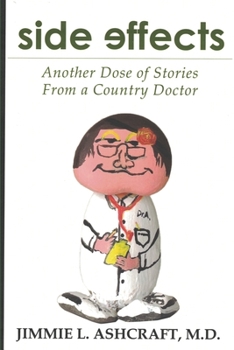
Side Effects: Another Dose of Stories From a Country Doctor
No Customer Reviews

I have had the good fortune of being a part of medicine in one way or another for almost six decades. During that time, I have seen advances in science that even to my most progressive thinking medical school mentors would seem unfathomable. All too often I appreciated how quickly old ideas and methods were discarded by colleagues when newer ones developed, only to find out later than the old way was often the better way, or the older drug, although out of favor for a time, was a better treatment.Sir William Osler (1849-1919), a Canadian physician considered by many to be the father of modern medicine and one of the four original founders of the Johns Hopkins Hospital and Medical School, astutely noted: "A look at the past will show that the philosophies of one age become the absurdities of the next, and the foolishness of yesterday becomes the wisdom of tomorrow." Caring for the sick was difficult for early American physicians since they had few diagnostic tools, minimal understanding of disease processes, and few effective treatments. If a disease could not be cured by consuming purging agents to empty the bowels, applying mustard plasters to the skin to draw out poisons, lancing boils, or bloodletting, there was no treatment except to allow the human body to heal itself. Sometimes the adverse effects from the treatments outweighed their benefits and were devastating to the patient. One doctor in the 1700s stated, "The harsh treatments punished sick people and could even shorten lives." The same observation could be made of today's patients who are undergoing chemotherapy for cancer or those patients in our intensive care units who are connected to various machines with tubes coming out of their bodies seemingly from everywhere. Indeed, the lines often become blurred between therapeutic effects and adverse effects of a therapy. The lines of difference change frequently when the discussion concerns babies or the elderly. Through the years, with all the changes in medical care, both good and bad, and the seemingly endless amount of human suffering, there has been at least one constant. There have been those who were willing to treat the ill and injured with the hope that they could make their patient better. Additionally, the patient had the expectation, warranted or not, that the physician's treatment would cure him. Sometimes the expectations were fulfilled; more often they were not. This book's title, Side Effects, is meant to hint at the unforeseen events that happen in everyday life and in medicine. Side effects7 from events or drugs may be considered both positive and negative depending upon the circumstances and one's point of view. Often there exists merely a fine line between a good side effect and a bad one. Most of the stories deal with unforeseen events; the reader can determine the side effects and if they were good or bad. I have included occasional historical notes or explanations inside the text with the hope that they will enhance the understanding of the story. This book recounts a few of my experiences from my clinical years. Like my previous books, Reflections of a Country Doctor and The Next Prescription, this book contains stories about real people, my patients, who allowed me the privilege of attending them. Some are silly, some are sad, some are funny, and some may make you mad.
Format:Paperback
Language:English
ISBN:1734519363
ISBN13:9781734519365
Release Date:February 2020
Publisher:Country Doctor Books
Length:218 Pages
Weight:0.72 lbs.
Dimensions:0.5" x 6.0" x 9.0"
Customer Reviews
0 rating
Copyright © 2026 Thriftbooks.com Terms of Use
| Privacy Policy | Do Not
Sell/Share My Personal Information | Cookie Policy | Cookie Preferences | Accessibility Statement
ThriftBooks® and the ThriftBooks® logo are registered trademarks of Thrift Books Global, LLC
ThriftBooks® and the ThriftBooks® logo are registered trademarks of Thrift Books Global, LLC
