


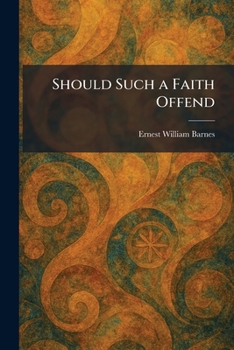
Should Such a Faith Offend

"Should Such a Aith Offend" is a compelling collection of sermons and addresses by Ernest William Barnes that examines the vital relationship between Christian doctrine and the modern scientific understanding of the world. Addressing the intellectual challenges of the early 20th century, the work seeks to bridge the gap between faith and reason, particularly concerning the theories of evolution and the physical sciences. Barnes, a prominent figure in the modernist movement of the Church of England, argues that a robust faith should not be offended by scientific progress but should instead find new depth within it.
The chapters explore a variety of theological and philosophical themes, including the nature of religious experience, the interpretation of scripture in a scientific age, and the role of the Church in contemporary society. By advocating for an intellectually courageous approach to spirituality, "Should Such a Aith Offend" serves as a landmark in the history of liberal theology. This work remains a significant contribution to the ongoing dialogue between science and religion, offering a vision of Christianity that is both deeply rooted in tradition and fully engaged with the discoveries of the modern era.
This work has been selected by scholars as being culturally important, and is part of the knowledge base of civilization as we know it. This work was reproduced from the original artifact, and remains as true to the original work as possible. Therefore, you may see the original copyright references, library stamps (as most of these works have been housed in our most important libraries around the world), and other notations in the work.
This work is in the public domain in the United States of America, and possibly other nations. Within the United States, you may freely copy and distribute this work, as no entity (individual or corporate) has a copyright on the body of the work.
As a reproduction of a historical artifact, this work may contain missing or blurred pages, poor pictures, errant marks, etc. Scholars believe, and we concur, that this work is important enough to be preserved, reproduced, and made generally available to the public. We appreciate your support of the preservation process, and thank you for being an important part of keeping this knowledge alive and relevant.
Customer Reviews
ThriftBooks ® and the ThriftBooks ® logo are registered trademarks of Thrift Books Global, LLC
