
Skip to content
Scan a barcode
Scan
Paperback Should America Pay?: Slavery and the Raging Debate on Reparations Book

ISBN: 0060083115

ISBN13: 9780060083113

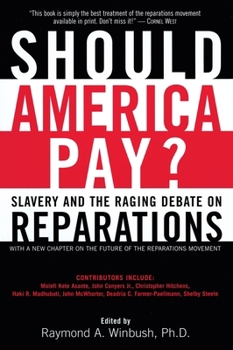
Should America Pay?: Slavery and the Raging Debate on Reparations

Select Format

Select Condition ThriftBooks Help Icon

Recommended

Format: Paperback

Condition: Very Good

$7.09
Save $7.90!
List Price $14.99
Almost Gone, Only 1 Left!
Save to List

Book Overview

Growing interest in reparations for African Americans has prompted a range of responses, from lawsuits against major corporations and a march in Washington to an anti-reparations ad campaign. As a result, the link between slavery and contemporary race relations is more potent and obvious than ever. Grassroots organizers, lawmakers, and distinguished academics have embraced the idea that reparations should be pursued vigorously in the courts and legislature. But others ask, Who should pay? And could reparations help heal the wounds of the past?

This comprehensive collection -- the only of its kind -- gathers together the seminal essays and key participants in the debate. Pro-reparations essays, including contributions by Congressman John Conyers Jr., Christopher Hitchens, and Professor Molefi Asante, are countered with arguments by Shelby Steele, Armstrong Williams, and John McWhorter, among others. Also featured are important documents, such as the First Congressional Reparations Bill of 1867 and the Dakar Declaration of 2001, as well as a new chapter on the current status and future direction of the movement.

Customer Reviews

5 ratings

Should America Read Should America Pay?

Should America Pay? edited by Raymond Winbush, is a book that is long overdue. Finally the case for reparations for the centuries of brutality, deprivation, and death suffered by millions of African descendants in the United States has been made openly and honestly by white and black writers. Dr. Winbush, has selected a distinguished group of scholars, academicians, and other intellectual luminaries and professionals to present what turns out to be a compelling case for reparations for African Americans. The book makes clear that remedial actions must be taken to begin to repair the state supported exploitation and subsequent damage in every area of African American life including - health (mental and physical), education, land ownership, and in the political and economic arenas to name a few. The hardships and savagery inflicted on millions of African captives forced to work as slaves in the US is clearly outlined in the book. Discussion in the book also focuses on why and how the surviving descendants are still suffering from the ongoing effects of what has been to date, a perpetually racist society. Most importantly, the book outlines solutions and some of the programs and projects reparations funding should be spent on in order to begin to repair the damge sustained and transmitted for generations.As a result of corporate control of the mass media, few Americans know that the question of whether or not reparations are owed to African Americans was resolved by the General Assembly of the United Nations at the August - September 2001 World Conference Against Racism held in Durban, South Africa (the US, by the way, walked out on this conference). The UN declared that the Transatlantic Slave Trade was a CRIME AGAINST HUMANITY and was ALWAYS a crime (despite claims that it was "legal" at the time). For crimes against humanity there is no statute of limitations. The UN Program of Action clearly states that reparations and remedial actions are in order and in fact long overdue. So Should America Pay? The verdict is in. The 168 coontries attending the UN conference stated a resounding YES in the final documents available at the UN websites. So should America read Should America Pay? Yes! People in this country need to know the truth about their history and then decide if slavery was wrong. For those who think slavery was OK, the UN does not agree with you. For those who feel slavery was wrong, read the book and find out just how wrong it was, then decide if justice should be done to rectify what even President Bush agrees was a crime. After centuries of human rights violations, there can be no true peace and brotherhood between the blacks and whites in this society until the score is justly settled on the slavery and racism issue once and for all. Read this book and find out why reparations for African Americans is like Sam Cooke sang: "a change that's got to come".

Compulsory Reading

Dr. Winbush should be applauded for compiling and editing this wealth of information for AMERICA. This text should be incorporated into the American History classes across our nation.We talk about the "holocaust" in all classrooms, an event that didn't happen in "our country". Yet, we don't want to ADDRESS and REPAIR the effects of slavery, something that took place in our own backyard. This book dispels the misconceptions associated with reparations in that it cites ways that reparations could be paid such as, educational grants, providing health care and land or property grants, not just lump sums to individuals as most people think.This is a must read for anyone seeking to learn more about the reparations movement.

Ray Winbush Responds

As editor of "Should America Pay?: Slavery and the Raging Debate on Reparations", I thought it might be helpful to answer one criticism that has been consistent about the book, but is better understood after a little background information is provided. I would classify the essays in the book under three broad categories: 1) those who favor reparations, 2) those who oppose them and 3) those who simply present the facts about the issue. Several people have commented about why there are so few articles from those who oppose them. While compiling the book, we asked several persons who were opposed to reparations for Africans in America to write and they simply said there was little legal, empirical or otherwise substantive research about why reparations *shouldn't* be made for Africans in America! Simply put, the arguments *against* reparations for Africans in America simply are weak. and are more emotional than logical. The oppositional essays included in the book are from three writers (and a fourth from an "embedded" David Horowitz in Christopher Hitchens' essay) who are simply the best voices out there. I approached a major conservative "think tank" (which I will leave nameless) about having one of their senior researchers write an essay for the book and was told that the "issue had been studied" but that "they" (the institution's researchers) could not mount a legal argument *against* reparations that was empirically based. I think if one follows the "logic" of reparations for Africans in America s/he they will come to the conclusion (as both supporters and opposers to reparations have) that it is based in solid legal theory, international law as well as historical precedent, e.g., Nuremburg. Finally, "Should America Pay?" was recently submitted to the U.S. Supreme Court as a "friends of the court" document involving the University of Michigan affirmative action case because of its comprehensive inclusion of views concerning compensatory measures for Africans in America. It is a book that if one reads it, will provide strong historical and legal evidence for the unpunished crime against humanity in the United States --- slavery. Read it with an open mind and you will see that not only are reparations due Africans in America, they will happen because it is the logical step in moving toward an honest discussion about racism (white supremacy) in the United States.

Phenomenal

One of the most enlightening and critically challenging analyses of the reparations issue to date. For readers seriously interested in understanding the issues and debate surrounding this hotly debated topic.

Before You Take a Stand on Reparations Read This Book!

In 'Should America Pay?' Dr. Winbush has succeeded in compiling a full spectrum of the arguments for and against reparations in such a manner that the average reader can gain a full understanding of the reparations movement. The most fascinating aspect of 'Should America Pay' is that Dr. Winbush has included not only historical reparations information but current happenings in the reparations movement including interviews of those living today who have been directly affected by slavery and the details of current reparations lawsuits filed against major American corporations.
Copyright © 2026 Thriftbooks.com Terms of Use | Privacy Policy | Do Not Sell/Share My Personal Information | Cookie Policy | Cookie Preferences | Accessibility Statement
ThriftBooks® and the ThriftBooks® logo are registered trademarks of Thrift Books Global, LLC

GoDaddy Verified and Secured