


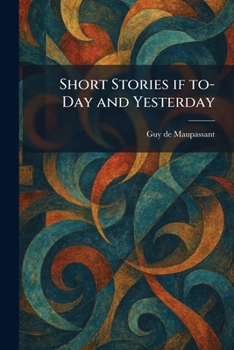
Short Stories If To-Day and Yesterday

"Short Stories of Today and Yesterday" is a curated collection of some of the most influential short fiction by Guy de Maupassant, a master of the French realist tradition. Renowned for his economy of style and his keen observation of the human condition, Maupassant's stories traverse the various strata of 19th-century French society, from the bustling streets of Paris to the rustic landscapes of Normandy.
This anthology showcases the author's unparalleled ability to weave tales of irony, tragedy, and social commentary. Within these pages, readers encounter themes of class struggle, the vanity of the bourgeoisie, and the lingering psychological impacts of war. Known for his twist endings and his unflinching depiction of human flaws, Maupassant remains a foundational figure in the development of the modern short story.
Whether exploring the complexities of romantic relationships or the harsh realities of peasant life, "Short Stories of Today and Yesterday" offers a comprehensive look at a writer who captured the essence of his era with precision and wit. This collection serves as a testament to Maupassant's lasting legacy as one of the most significant voices in world literature, providing timeless insights into the ironies and triumphs of daily existence.
This work has been selected by scholars as being culturally important, and is part of the knowledge base of civilization as we know it. This work was reproduced from the original artifact, and remains as true to the original work as possible. Therefore, you may see the original copyright references, library stamps (as most of these works have been housed in our most important libraries around the world), and other notations in the work.
This work is in the public domain in the United States of America, and possibly other nations. Within the United States, you may freely copy and distribute this work, as no entity (individual or corporate) has a copyright on the body of the work.
As a reproduction of a historical artifact, this work may contain missing or blurred pages, poor pictures, errant marks, etc. Scholars believe, and we concur, that this work is important enough to be preserved, reproduced, and made generally available to the public. We appreciate your support of the preservation process, and thank you for being an important part of keeping this knowledge alive and relevant.
Customer Reviews
ThriftBooks ® and the ThriftBooks ® logo are registered trademarks of Thrift Books Global, LLC
