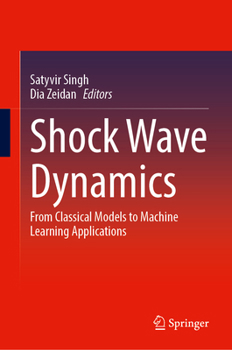
Shock Wave Dynamics: From Classical Models to Machine Learning Applications

From Classical Models to Machine Learning Applications offers a forward-looking exploration of shock wave phenomena, combining rigorous theory, high-fidelity computation, and modern artificial intelligence. Across five parts, it begins with the mathematical foundations of shock mechanics, including continuum and non-equilibrium formulations and characteristic shock dynamics in multiphase flows such as rotational dusty gas. It then presents advanced computational methods: high-order WENO schemes, discontinuous Galerkin methods, moment-based DSMC, and the Unified Gas-Kinetic Scheme, with an engineering case study of supersonic intakes for ramjet-assisted artillery. Further chapters examine shock-interface interactions, shock-vortex dynamics, and instability development. A dedicated part shows how data-driven modeling and physics-informed neural networks improve predictive accuracy, with applications to curved converging channels and Fanno flow. The final part outlines open challenges and future directions. Written for researchers, graduate students, and industry professionals in aerospace engineering, CFD, applied mathematics, and gas dynamics, this Springer Nature volume charts a path for next-generation high-speed flow physics and AI-enhanced computational science.
Related Subjects
Engineering Science Science & Math Science & Scientists Science & Technology TechnologyCustomer Reviews
ThriftBooks ® and the ThriftBooks ® logo are registered trademarks of Thrift Books Global, LLC