


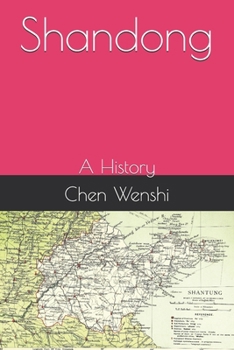
Shandong: A History
No Customer Reviews

Shandong is often described as the bedrock of Chinese civilization, a land where the nation's philosophical, political, and spiritual identity was forged. This comprehensive history traces the province's journey from the prehistoric Longshan culture and the enigmatic "Eastern Barbarians" to its emergence as the classical world's epicenter of thought. As the home of Confucius, Mencius, and Sun Tzu, Shandong served as the intellectual wellspring of East Asia, defined by the dual heritage of the ritual-bound state of Lu and the commercially dynamic, pragmatic state of Qi. Through the rise and fall of dynasties, the province remained a vital axis for the empire, anchored by the sacred peaks of Mount Tai and the volatile, life-giving waters of the Yellow River. The narrative dives deep into the turbulent middle centuries, exploring Shandong's role as a maritime gateway and a perpetual battleground. From the golden era of Buddhist art in the Tang and Song dynasties to the devastating Mongol and Jurchen conquests, the region has long been shaped by an interplay between continental tradition and oceanic exchange. The book provides a detailed look at the province's encounter with the modern world, beginning with the arrival of Western powers and the German concession of Qingdao. These colonial intrusions sparked the Boxer Uprising and later ignited the May Fourth Movement, a pivotal moment in Chinese nationalism sparked by the "Shandong Problem" at the Treaty of Versailles. In the 20th century, the province became a theater for staggering conflict and radical social change. The text examines the chaotic Warlord Era and the brutal occupation during the Second Sino-Japanese War, which saw the rise of a powerful Communist resistance in the rural mountains. Following the revolutionary victory in 1949, Shandong became a laboratory for Maoist experimentation. Readers are given a raw look at the triumphs and tragedies of this period, from the man-made catastrophe of the Great Leap Forward to the iconoclasm of the Cultural Revolution, which saw the ancient temples of Qufu desecrated by Red Guards. The final chapters document Shandong's dramatic rebirth as a global economic powerhouse. Following the reforms of Deng Xiaoping, the province transformed from a weary agrarian landscape into an industrial titan, giving rise to iconic global brands like Haier and Tsingtao Brewery. This modern evolution-characterized by the "Shandong Model" of state-guided growth-has turned the peninsula into a hub for high-tech manufacturing and the "Blue Economy." Today, the province balances its role as a 21st-century technological leader with a profound state-sanctioned revival of its Confucian roots. This sweeping epic is an essential resource for understanding the forces that shaped China. By examining the interplay of the mountain, the river, and the sea, the book reveals how Shandong's history of resilience, innovation, and intellectual ferment continues to influence the trajectory of the modern Chinese state. It is a story of a land that has been a cradle of sages, a victim of foreign aggression, and a model of modern development.
Format:Paperback
Language:English
ISBN:B0GZGMK7GT
ISBN13:9798195395353
Release Date:May 2026
Publisher:Independently Published
Length:168 Pages
Weight:0.51 lbs.
Dimensions:0.4" x 6.0" x 9.0"
Related Subjects
HistoryCustomer Reviews
0 rating
Copyright © 2026 Thriftbooks.com
Terms of Use | Privacy Policy | Do Not Sell/Share My Personal Information | Cookie Policy | Cookie Preferences | Accessibility Statement
ThriftBooks ® and the ThriftBooks ® logo are registered trademarks of Thrift Books Global, LLC
ThriftBooks ® and the ThriftBooks ® logo are registered trademarks of Thrift Books Global, LLC
