


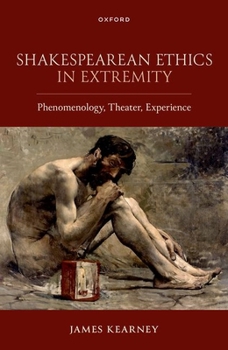
Shakespearean Ethics in Extremity: Phenomenology, Theater, Experience
No Customer Reviews

Shakespearean Ethics in Extremity addresses forms of ethical experience on the Shakespearean stage. Early modern theater traffics in the vicarious experience of ethics, often ethics in some extreme or impossible circumstance. It does so not by parading concepts across the stage or ventriloquizing ideas from the philosophical tradition but by bringing to life stories and characters and worlds, by crafting scenes and moments of great emotional and cognitive intensity. What does it feel like to be enjoined to avenge your father's murder? What is it like to banish your daughter or disavow your community? To murder? James Kearney contends that Shakespearean theater, fundamentally oriented to the experiential, invites its audiences to entertain and to be entertained by what the philosopher Bernard Williams calls "a phenomenology of the ethical life." The early modern world inherited and developed rhetorical and philosophical practices geared toward the creation of immersive virtual experience. These phenomenological arts share underlying assumptions about the cultivation and management of the self as well as a straightforward orientation toward ethics. Taking up key concepts from the long history of moral philosophy -- recognition, obligation, decision, luck -- Shakespearean Ethics in Extremity brings together a discursive history of ideas and the more phenomenological realms of body and affect, environment and world. In Shakespearean theater we encounter or witness or simply have our attention called to the ethical problem of other minds, the obligation to neighbor and community, the mysteries of decision, the moral quandaries posed by epistemological uncertainty, the risk of ethico-affective relations, and the vagaries of luck. Each of these concepts points to an elemental aspect of ethical life, and they all have long and rich histories, ancient and modern. With a concentrated focus on formally inventive plays written in the later part of Shakespeare's theatrical career - King Lear, Timon of Athens, Macbeth, Pericles, The Tempest, and The Winter's Tale -- Kearney explores Shakespearean theater as an arena or lab in which the experience of ethics in extremis is simulated or reverse engineered, counterfeited or created.
Format:Hardcover
Language:English
ISBN:0198954565
ISBN13:9780198954569
Release Date:July 2025
Publisher:Oxford University Press
Length:272 Pages
Weight:1.20 lbs.
Dimensions:0.6" x 6.4" x 9.3"
Customer Reviews
0 rating
Copyright © 2026 Thriftbooks.com
Terms of Use | Privacy Policy | Do Not Sell/Share My Personal Information | Cookie Policy | Cookie Preferences | Accessibility Statement
ThriftBooks ® and the ThriftBooks ® logo are registered trademarks of Thrift Books Global, LLC
ThriftBooks ® and the ThriftBooks ® logo are registered trademarks of Thrift Books Global, LLC
