


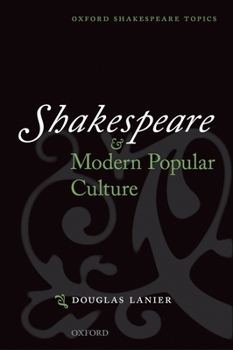
Shakespeare and Modern Popular Culture

Select Format
Select Condition 
Book Overview
Our notions of Shakespeare have been shaped partly by his diffuse presence in films, comics, television, popular novels, kitsch, and advertising. Through a series of case studies, Douglas Lanier examines how modern popular culture has appropriated and refashioned Shakespeare as a cultural
icon.
icon.
Format:Paperback
Language:English
ISBN:0198187068
ISBN13:9780198187066
Release Date:November 2002
Publisher:Oxford University Press, USA
Length:200 Pages
Weight:0.50 lbs.
Dimensions:0.5" x 6.0" x 7.5"
Customer Reviews
1 rating
Think You Know Shakespeare? Nobody Does.
Published by Thriftbooks.com User , 23 years ago
Douglas Lanier provides a fascinating account of how the man Shakespeare has been lionized, sanitized, and satirized over the three hundred years since he was first promoted as England's national poet in the 1730's. Since then, Shakespeare and the plays he wrote for the popular Elizabethan theatre have been appropriated by different cultural factions, both high and low, to advance particular ideas of what constitutes (or does not constitute) "proper" cultural ideals. Lanier examines how this has happened in the past and continues to happen in the present. Each chapter of Lanier's book focuses on a different aspect of what he calls "Shakespop." Lanier skillfully portrays the long historical process of elevating Shakespeare's plays to the peak of English high culture. This process began with the publication of the First Folio in 1623, thereby preserving plays written to be performed in the Elizabethan playhouse as timeless literature. Before long, Shakespeare's works were promoted as emblematic of a natural English realism against the classical standards of dramatic economy in time and action as represented by the Englishman's perpetual enemies, the French. Lanier offers extensive demonstration that since that time Shakespeare's plays-and increasingly the image of Shakespeare himself as a "natural genius"-has continued to play a leading role in cultural warfare. Alluding to Shakespeare's works or citing them is a means of indicating a connection to high culture or making a protest against that culture. The plays have been used and abused in adaptations and parodies, while the constant reinvention of Shakespeare the man has served to suit different cultural needs, either for the cultural elite or those who feel dispossessed by them. Lanier concludes with a fascinating overview of the phenomenon of Shakespeare tourism and Shakespeare theatre festivals that serve to give tourists both a quick dose of high culture and a sense of getting to know the "real" Shakespeare, either by visiting his hometown of Stratford or seeing one of his plays performed in an recreated Elizabethan theatre with historical costume. Lanier illustrates his points admirably with a host of pertinent examples from British and American culture, high, low and middling, and insightfully dissects those examples to expose their hidden assumptions and agendas.Because this is a short study, many readers will wish Lanier had addressed their own particular interests in popular culture. Although he cites examples from television, books, comics, and animated cartoons, I would have liked to read more of his reflections on the ways Shakespeare works are mediated to children in American popular culture. As a non-specialist, I'm also interested in the connection between Shakespeare and the ham actor, as for example in Ernst Lubitsch's film "To Be or Not to Be." But the reader's desire for more is an indication of how provocative and interesting Lanier's study is for both the professional and the
Copyright © 2026 Thriftbooks.com
Terms of Use | Privacy Policy | Do Not Sell/Share My Personal Information | Cookie Notice | Cookie Preferences | Accessibility Statement
ThriftBooks ® and the ThriftBooks ® logo are registered trademarks of Thrift Books Global, LLC
ThriftBooks ® and the ThriftBooks ® logo are registered trademarks of Thrift Books Global, LLC
