


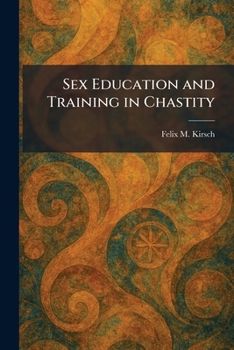
Sex Education and Training in Chastity

"Sex Education and Training in Chastity" is a comprehensive pedagogical guide designed to assist parents, teachers, and clergy in navigating the complexities of moral and physical development from a traditional Catholic perspective. Written by Rev. Felix M. Kirsch, this work emphasizes the integration of biological facts with spiritual values, advocating for a balanced approach to instruction that prioritizes the cultivation of virtue. The text provides a clear framework for addressing sensitive topics, arguing that true education must go beyond mere physiological information to include the formation of the will and the preservation of modesty.
The book explores the shared responsibilities of the family, the school, and the church in fostering a well-rounded character. It delves into practical methods for teaching self-control and the importance of moral integrity during the formative years. By addressing the psychological aspects of growth through the lens of faith, "Sex Education and Training in Chastity" offers an insightful historical perspective on Christian ethics and educational theory. This work remains a significant resource for those interested in the history of Catholic pedagogy and the perennial challenge of guiding young people toward a life of discipline and moral clarity.
This work has been selected by scholars as being culturally important, and is part of the knowledge base of civilization as we know it. This work was reproduced from the original artifact, and remains as true to the original work as possible. Therefore, you may see the original copyright references, library stamps (as most of these works have been housed in our most important libraries around the world), and other notations in the work.
This work is in the public domain in the United States of America, and possibly other nations. Within the United States, you may freely copy and distribute this work, as no entity (individual or corporate) has a copyright on the body of the work.
As a reproduction of a historical artifact, this work may contain missing or blurred pages, poor pictures, errant marks, etc. Scholars believe, and we concur, that this work is important enough to be preserved, reproduced, and made generally available to the public. We appreciate your support of the preservation process, and thank you for being an important part of keeping this knowledge alive and relevant.
Customer Reviews
ThriftBooks ® and the ThriftBooks ® logo are registered trademarks of Thrift Books Global, LLC
