


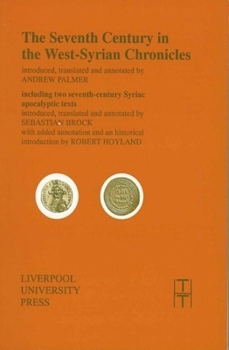
The Seventh Century in the West Syrian Chronicles

The Seventh Century in the West-Syrian Chronicles makes accessible to a wide public sources vital for the reconstruction of events in the first Islamic century, covering the period which ends with the unsuccessful Arab siege of Constantinople, an event which both modern historians and Syriac chronographers see as making a decisive caesura in history. The general introduction enables a newcomer to the field to establish his bearings before tackling the texts.
Format:Paperback
Language:English
ISBN:0853232385
ISBN13:9780853232384
Release Date:March 1993
Publisher:Liverpool University Press
Length:352 Pages
Weight:1.15 lbs.
Dimensions:0.8" x 5.8" x 8.3"
Customer Reviews
1 rating
A gem of a collection
Published by Thriftbooks.com User , 17 years ago
This book is one of the very helpful series "Translated Texts for Historians," published by Liverpool University Press. It brings together many chronicles and extracts from chronicles written in the Syriac language about the 7th century AD, that is, the century in which Islam emerged and rapidly spread throughout the Near East and North Africa. The translations and the introductions to individual texts were done by Andrew Palmer. A historical introduction and occasional historical comments throughout the book were done by Robert Hoyland. Two apocalypses, which finish out the collection, were translated and introduced by Sebastian Brock. The translations are very readable, and the introductions and notes provide useful information for understanding how these texts relate to the history they narrate and how, in many cases, they relate to each other. This book provides valuable insight into how Christians in the Near East viewed and reacted to the series of Arab incursions which eventually led to the establishment of the Muslim empire. From our perspective, we often do not realize that in AD 632 (the year of Muhammad's death), the Arabs did not know that their raids would actually lead to a viable empire, and the Byzantines and Persians (the superpowers of the time) had no idea that the annoying behavior of a group that they regarded as ragtag barbarians would actually produce a lasting polity. As awareness of this reality set in, Syriac Christians produced some small historical works that documented the events fairly close to the time they occurred. Later many of these documents were incorporated into larger histories written by men who could see the course that events had taken over the long term. In addition to histories, the desperate times (from the Christian perspective) produced a flood of apocalyptic literature, as many became convinced that the "end times" were upon them. This is the reason for the inclusion of the two apocalypses at the end of the book. There was a widespread expectation among the first generations under Islam that the Byzantine Empire would rebound and throw off the Muslim yoke. As time went by and it became clear that the Byzantine recovery was not imminent, hope began to move to the "Last Greek King" and an end-time release of twenty or so barbaric nations supposedly walled up somewhere in "the north" by Alexander the Great. It makes for fascinating reading and provides an interesting parallel to modern mythologies developed to deal with contemporary anxieties about the "end times."
Copyright © 2026 Thriftbooks.com Terms of Use
| Privacy Policy | Do Not
Sell/Share My Personal Information | Cookie Policy | Cookie Preferences | Accessibility Statement
ThriftBooks® and the ThriftBooks® logo are registered trademarks of Thrift Books Global, LLC
ThriftBooks® and the ThriftBooks® logo are registered trademarks of Thrift Books Global, LLC
