


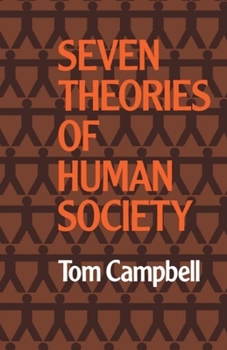
Seven Theories of Human Society

Select Format
Select Condition 
Book Overview
The social sciences cover a wide field, and in this introductory book Tom Campbell presents seven contrasting theories of significance for sociology, politics, economics, law, psychology, and history. His concern is to clarify the logical structure, methodological assumptions, and practical implications of the different theories, with the aim of encouraging informed and critical study of social thought. He begins in Part I with a discussion of the nature of social and political theory and an outline of the ways in which different theories may be compared and assessed. In Part II he examines and contrasts seven major theories. Although he presents the theories in terms of individual thinkers, each theorist provides a vehicle for the study of a particular important type of theory. Against the historical perspective of Aristotle's theory of man, Hobbes's egoistic theory, and Adam Smith's idea of the social system, Professor Campbell sets the modern giants: Marx and conflict theory, Durkheim and consensus theory, and Weber's theory of social action. Finally, Alfred Schutz serves as a bridge to such recent developments as ethnomethodology. The chronological order of presentation illustrates the development of social theory and the way in which it is affected by social change. The book concludes in Part III with a consideration of some of the philosophical issues which underlie the main differences between the seven types of social theory. The combination of information and analysis, and the selection of theorists of significance for a wide range of social sciences, make this book an invaluable introduction to the study of human society and historically important types of social theory.
Format:Paperback
Language:English
ISBN:0198761058
ISBN13:9780198761051
Release Date:November 1981
Publisher:OUP Oxford
Length:250 Pages
Weight:0.88 lbs.
Dimensions:0.6" x 5.3" x 8.0"
Customer Reviews
1 rating
Brief Review of Tom Campbell's Seven Theories of Human Society
Published by Thriftbooks.com User , 18 years ago
This is a strong statement of the potential of social theory. It is the most excellent and eloquent treatment of sociological theories that I have read. It covers theories of society from the classical theories of Aristotle to humanistic theories of Alfred Schutz. I found the overall argument of the book most compelling and the discussions passionate and for the most part accurate. I was particularly interested in the criteria the author used for evaluating theories and the discussions of Marx, Weber, and Durkheim; the coverage of Marx, Weber, and Durkheim is excellent and the author captures much of their contributions to theory. It is a most unusual book. I can see that the author thought deeply about the issues. His treatment of sociological theory should make every student feel comfortable with theoretical thinking. The amazing thing is that even with all the changes that have occurred in sociological theorizing over the years since this book was first published; the author makes a statement that is still relevant and fresh.
Copyright © 2026 Thriftbooks.com Terms of Use
| Privacy Policy | Do Not
Sell/Share My Personal Information | Cookie Policy | Cookie Preferences | Accessibility Statement
ThriftBooks® and the ThriftBooks® logo are registered trademarks of Thrift Books Global, LLC
ThriftBooks® and the ThriftBooks® logo are registered trademarks of Thrift Books Global, LLC
