


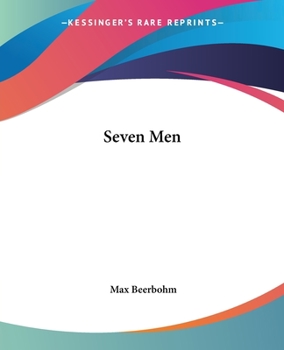
Seven Men


Select Format
Select Condition 
Book Overview
Seven Men is a collection of seven essays written by the renowned English essayist and caricaturist, Max Beerbohm. The book was first published in 1919 and has since become a classic of English literature. The essays in this collection are each a character sketch of a different man, ranging from famous literary figures to obscure acquaintances of the author. The first essay is a portrait of George Bernard Shaw, the famous playwright and critic. Beerbohm's essay is a witty and satirical take on Shaw's personality and writing style. The second essay is a sketch of the author's father, a wealthy businessman who was known for his eccentricities. The third essay is a tribute to the English poet and playwright, William Butler Yeats. Beerbohm's essay is a thoughtful and insightful analysis of Yeats' poetry and his place in the literary world. The fourth essay is a portrait of the author's friend, the artist Aubrey Beardsley, who died young but left a lasting impact on the art world. The fifth essay is a sketch of the author's old schoolmaster, a man who was known for his strict discipline and his love of Latin. The sixth essay is a portrait of the author's friend, the writer and critic Walter Pater. Beerbohm's essay is a thoughtful and nuanced exploration of Pater's philosophy and writing style. The final essay in the collection is a portrait of the author himself, written in the third person. In this essay, Beerbohm reflects on his own life and career as a writer and caricaturist. Overall, Seven Men is a fascinating collection of essays that offers a unique glimpse into the personalities and lives of some of the most interesting men of the early 20th century. Beerbohm's writing is witty, insightful, and often humorous, making this book a joy to read for anyone interested in English literature and culture. What I had done was not merely base: it was very dangerous. I was in terror that she might rally him on his devotion to London. I didn't dare to move away. I was immensely relieved when at length she said she must be going.This scarce antiquarian book is a facsimile reprint of the old original and may contain some imperfections such as library marks and notations. Because we believe this work is culturally important, we have made it available as part of our commitment for protecting, preserving, and promoting the world's literature in affordable, high quality, modern editions, that are true to their original work.
Format:Paperback
Language:English
ISBN:1419146815
ISBN13:9781419146817
Release Date:June 2004
Publisher:Kessinger Publishing, LLC
Length:100 Pages
Weight:0.42 lbs.
Dimensions:0.3" x 7.6" x 9.2"
Customer Reviews
2 ratings
The Divine Max
Published by Thriftbooks.com User , 25 years ago
Bernard Shaw called Beerbohm "the divine Max," and this collection of short pieces will tell you why. The book consists of short character sketches of six men (Beerbohm is the ever present seventh), and each one is a small masterpiece of Edwardian parody and humour. Beerbohm's line sketches of each one of his (imaginary?!) characters are included at the end of the book. Some of the tales have an unexpectedly supernatural twist (the neo-Faustian bargain struck by Enoch Soames being the best of the lot). Three cheers for the NYRB Press for bringing these forgotten gems back into print.
The juggler vs. the strong man
Published by Thriftbooks.com User , 25 years ago
I first read "Seven Men" a few years back when Harold Bloom listed it as essential reading in his book on the Western canon.The book consists of short fictional portraits of various characters in the world of Edwardian arts and letters. Beerbohm was a satirist with a nimble touch -- he had the ability to poke fun at the pretensions of the art world while maintaining a gentle, bemused humanism. Sir Max seemed to view the vanity and foibles of human nature not so much with scorn as with an endless amusement, and reading any of his essays or parodies or satires is like spending the evening chatting with a wise and witty friend.Beerbohm once wrote, "How many charming talents have been spoiled by the instilled desire to do 'important' work! Some people are born to lift heavy weights. Some are born to juggle with golden balls." Beerbohm was an admitted juggler, and yet his seemingly "light" work is ultimately more insightful than most so-called serious projects. And often much funnier.Beerbohm was also quite a caricaturist, and his theater reviews (many out of print) are still great to read all these decades later.Get hold of this book and start off with the classics "Enoch Soames," the story of a third-rate poet who, convinced of his own greatness, makes a deal with the Devil in order to travel to the future to enjoy his posthumous success (with comic results), and "Savonarola Brown," a hilarious sketch of a frustrated playwright and his great "unfinished" opus.Beerbohm's contemporaries referred to him as "the incomparable Max," and it's a title that fits. I wish I could've met him.
Copyright © 2026 Thriftbooks.com
Terms of Use | Privacy Policy | Do Not Sell/Share My Personal Information | Cookie Notice | Cookie Preferences | Accessibility Statement
ThriftBooks ® and the ThriftBooks ® logo are registered trademarks of Thrift Books Global, LLC
ThriftBooks ® and the ThriftBooks ® logo are registered trademarks of Thrift Books Global, LLC
