


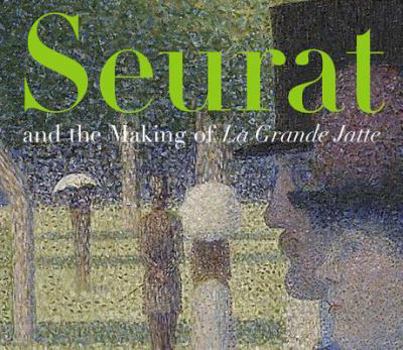
Seurat and the Making of La Grande Jatte


Select Format
Select Condition 
Book Overview
"The miracle of La Grande Jatte is its coincidence of critical distinction and popular celebration. High, low, mass, and popular cultures meet in mutual delight, continuing to revel in the mysteries of that Parisian Sunday."--from "The Park in the Museum" by Neil Harris
"Bedlam," "scandal," and "hilarity" were among the epithets used to describe the effect of what is now considered Georges Seurat's greatest work, and one of the most remarkable paintings of the nineteenth century, when it was first exhibited in Paris in 1886. A Sunday on La Grande Jatte--1884, an extensive landscape peopled with over forty figures, took the artist almost two years to complete. This sumptuous book, created to accompany a major exhibition at the Art Institute of Chicago, provides a fascinating, in-depth examination of the gestation, execution, and influence of Seurat's masterpiece.
La Grande Jatte has been part of the Art Institute of Chicago's collection since 1926. Bringing together all known studies and drawings directly related to the painting, this volume provides a visual and contextual survey of Seurat's working methods and aesthetic priorities, as well as the evolutionary process that culminated in his singular achievement. Included are more than fifty-five preparatory works, ranging from rich cont crayon drawings to oil sketches on small wood panels to larger studies painted on canvas. In their quantity, intricacy, and variety, these works reveal a compositional process that harks back to Old Master traditions and methods, which had been largely abandoned by Seurat's immediate predecessors, the Impressionists. The many studies attest to the artist's ambitions for his masterpiece and open up a broader context for understanding the work.
Seurat scholar Robert L. Herbert makes new revelations about the painting's relationship to its preparatory studies, stressing Seurat's empirical craftmanship. He compares La Grande Jatte to paintings by Monet, Renoir, Pissarro, and Signac and analyzes the ways that twentieth-century critics, including Meyer Schapiro, T.J. Clark, and Linda Nochlin, have viewed the picture. He proposes that the enduring fascination of the famous canvas comes from Seurat's mixture of fashion and irony. Also giving new perspectives in this book, the noted cultural historian Neil Harris charts how and why La Grande Jatte attained its revered status at the Art Institute of Chicago and throughout the United States. Additionally, the exhibition's cocurators examine the painting's place in the museum's collection. Essays by Art Institute conservators show how Seurat transferred and altered figures from studies to final canvas and elucidate the exact nature of his pigments and brushwork. Color scientist Roy Berns traces the efforts to digitally recapture the original hues of Seurat's time-altered masterpiece. A landmark publication, this book provides dazzling proof of why La Grande Jatte is among the most frequently reproduced paintings in the world and why it continues to fascinate scholars and art lovers today.
Format:Hardcover
Language:English
ISBN:0520242106
ISBN13:9780520242104
Release Date:July 2004
Publisher:University of California Press
Length:288 Pages
Weight:3.70 lbs.
Dimensions:1.2" x 11.7" x 10.4"
Customer Reviews
3 ratings
Obsessed with Seurat's "La Grand Jatte"? I am
Published by Thriftbooks.com User , 17 years ago
If your level of obsession with this painting is on the order of 9 or 10 out of 10, please favor yourself with the acquisition of this book - or at least borrow it from your local library. Duh, this has the goods here about What, When, Why, How, Who on the famous painting, Seurat's preparatory studies and all things related. I am planning to produce a prodigious copy of the painting for my upstairs hallway (I said I was obsessed)and this pretty much delivers the goods on the best approach to doing so. The book has that highly-researched level of detail that only art classicism can afford you. Good Times!
The Envy of Institutions Worldwide
Published by Thriftbooks.com User , 18 years ago
A whole book (288 pages) dedicated solely to the making of one painting? How much can be discussed about one painting? Indeed a most grand impressive project commemorating a most beautiful masterpiece. Your interest in this book demonstrates your love for art. This book shall not disappoint you in its fullfillment. It assumes your familiarity with the artist and goes on to build from there. The technical research that went into producing this book is evident in its in-depth presentation. It begins with influences and planning drawings. Rough color sketches are beautiful in their own right. Comparasins are made to what other major artists (Renoir, Monet, Van Gogh, Signac) were doing at the time. But the true beauty in this book is in its technical investigations. Grid analysis, x-ray alignments, progressive figure staging. Additions and changes Seurat made during his 1885-86 reworking. Then in its final dissection one is brought beneath the surface. In high resolution photomicrographs you see the intricate color reflectance employed by Seurat. The cross section of paint chips and the ultra high magnification of the various (postage stamp) sections is fascinating. Is this how one looks at art? When you first approach 'La Grande Jatte' you can feel the palpable "life" which it posseses (its inherent beauty). Then after your initial tachypnia resolves and you are yearning to know more about this masterpiece. This is the book to turn to. And thus further realize its compositional ambition.
The Art Institute of Chicago Seurat exhibition catalogue
Published by Thriftbooks.com User , 21 years ago
"Seurat and the Making of 'La Grande Jatte'" was a major exhibition at the Art Institute of Chicago from June 19 to September 19, 2004 in Regenstein Hall. Even before it inspired the Stephen Sondheim musical "Sunday in the Park with George" or became a stopping point for the kids playing hooky in "Ferris Bueller's Day Off," the 1884 painting by Georges Seurat has been one of the most beloved, famous, and frequently reproduced paintings in the world. This year the Art Institute put together the first comprehensive exhibition of La Grande Jatte and its many related drawings and oil paintings, including approximately 130 paintings and other works: "The exhibition Seurat and the Making of 'La Grande Jatte' seeks to examine a familiar picture afresh and consider why it has so captured the public imagination. By situating La Grande Jatte in the context of Seurat's artistic development, his dialogue with the Impressionists, and the many preparatory studies produced over the two years of its creation, we can arrive at a richer appreciation of its unforgettable appeal-the way it holds in exquisite balance tradition and innovation, a sense of the momentary and of timelessness, wit and solemnity." Specifically the exhibit brought together about 45 of the artist's paintings and drawings related to the picture-from rich, yet delicate, conté crayon studies to oil sketches on small wood panels to nearly full-size paintings. The exhibition showed some of Seurat's early works and documents the way his choice of subject matter and use of colors changed around 1883-85, the period when he began exploring the modern-life subjects, high-keyed colors, and broken brushwork of Impressionism. This is the 288-page catalogue for the exhibition in which Seruat scholar Robert L. Herbert examines in depth the relationship between the finished painting and Seurat's preparatory studies, Herbert focuses on the empirical craftsmanship of the artist. That Seurat would be a revolutionary figure in the history of art is rather surprising, but his theory of "divided color" would lead to his distinctive style of pointillism. The exhibition looks not only at Seurat's early work, such as a sketch for "Bathing Place, Asnières" (1883-84) and the studies that he did for this painting, but also the works of Claude Monet, Pierre Auguste Renoir, and Camille Pissarro, that Seurat admired. Then there are works by Paul Signac and Lucien Pissarro, both of whom shared Seurat's interest in the divided-color/pointillist technique and which were featured in the same room at the exhibition that first presented "La Grande Jatte" to the world at the eight Impressionist exhibition in May 1886. The book also has an essay by cultural historian Neil Harris charts on how "A Sunday on La Grande Jatte" became one of the Art Institute's most famous works (along with Grant Wood's "American Gothic"). Douglas W. Druick (Searle Curator of European Painting and Prince Trust Curator of Prints and Drawing
Copyright © 2026 Thriftbooks.com
Terms of Use | Privacy Policy | Do Not Sell/Share My Personal Information | Cookie Notice | Cookie Preferences | Accessibility Statement
ThriftBooks ® and the ThriftBooks ® logo are registered trademarks of Thrift Books Global, LLC
ThriftBooks ® and the ThriftBooks ® logo are registered trademarks of Thrift Books Global, LLC
