


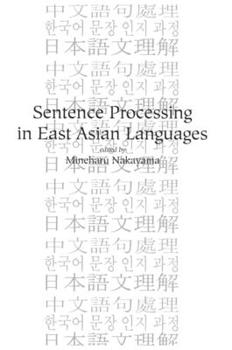
Sentence Processing in East Asian Languages: Volume 122
No Customer Reviews

Select Format
Select Condition 
Book Overview
Researchers in the fields of linguistics, psychology, cognitive science and neuro-science have long been interested in the impact of the development of a universal theory of how humans process language. Many believe that the creation of such a theory could possibly assist in the understanding of how the human brain works. For this reason, much research has been performed on sentence processing in English and other Indo-European languages. Yet, East Asian languages such as Chinese, Japanese, and Korean have received little attention. This volume is the first of its kind to discuss how native speakers of Chinese, Japanese, and Korean process sentences in their native tongues. Although these three languages share similar characteristics, the volume acknowledges and discusses specific issues that are unique to each language. Contributors explore the effects of homophones on lexical ambiguity in Chinese, and investigate the impact of word order on structural ambiguity in Japanese and working memory in Korean. The findings presented have important implications for sentence processing and cognitive processing models, and by extension contribute toward the construction of a universal theory of human language processing.
Format:Paperback
Language:English
ISBN:1575863081
ISBN13:9781575863085
Release Date:March 2001
Publisher:Center for the Study of Language and Informat
Length:304 Pages
Weight:0.93 lbs.
Dimensions:0.7" x 6.3" x 9.0"
Customer Reviews
0 rating
Copyright © 2025 Thriftbooks.com
Terms of Use | Privacy Policy | Do Not Sell/Share My Personal Information | Cookie Policy | Cookie Preferences | Accessibility Statement
ThriftBooks ® and the ThriftBooks ® logo are registered trademarks of Thrift Books Global, LLC
ThriftBooks ® and the ThriftBooks ® logo are registered trademarks of Thrift Books Global, LLC
