


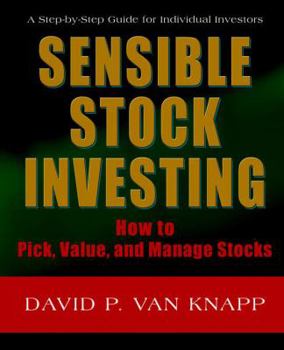
Sensible Stock Investing: How to Pick, Value, And Manage Stocks

For the millions of individual stock investors who want to improve their results-and for beginners who want to get started on the right foot-"Sensible Stock Investing: How to Pick, Value, and Manage... This description may be from another edition of this product.
Format:Paperback
Language:English
ISBN:059539342X
ISBN13:9780595393428
Release Date:January 2006
Publisher:Iuniverse Inc
Length:317 Pages
Weight:1.30 lbs.
Dimensions:9.0" x 0.8" x 7.3"
Customer Reviews
5 ratings
A virtual bible for the individual investor
Published by Thriftbooks.com User , 19 years ago
This book stands head and shoulders above the great bulk of what I've read on the subject of stock investing. Much of what's out there these days seems to have been written either for the gullible, get rich quick types or for those who have completely given up on trying to come out ahead of the pack and have resigned themselves to the boredom of simply buying and holding index funds. But this book's premise is that the small individual investor actually can beat the market, not through some secret, author-discovered formula, but by applying logic, discipline, and a bit of effort. If you believe, as I do, that knowledge and diligence tend to be rewarded in the Market as in life generally, you're going to like this book. The author does a great job of smoothly guiding the reader through a potentially dry and difficult subject, without presuming any particular prior knowledge or experience. In fact, the book could almost serve as a textbook on how the stock market operates if it weren't such a quick and enjoyable read. The contents are well organized, and the writing is clear and to the point. The author effectively uses two real world portfolios to demonstrate the application of his techniques and at the same time buttress his credibility. There are also several helpful appendices, including forms for valuing companies and reviewing a portfolio, as well as a handy investment calendar. One other thing that makes this book special is the feeling it conveys throughout that stock investing can and should be approached as an engaging, enjoyable hobby, like, say, belonging to a fantasy football league. I think an investor who maintains such an attitude is the most likely to stick with the sound techniques this book espouses while at the same time he or she reaps an extra dividend of happiness.
A useful guide to buying good companies at reasonable prices
Published by Thriftbooks.com User , 19 years ago
The author uses a "points system" to identify potential investment opportunities. Returns on equity and dividend history are given the greatest weight, followed closely by historical and forecast earnings per share. Since the rating system takes multiple factors into account, a low score in one area does not automatically exclude a company from consideration. Points are also awarded to companies that have compelling stories. Is the company a dominant player in its industry? Does the company have pricing power? Answers to questions like these will begin to narrow the range of possible investment candidates. To assist in that effort, the book includes a "company story" questionnaire that investors will find useful. For stock valuation, the system looks at historical and projected price/earnings, price/earnings growth ("PEG") ratios, and dividend yields. Discounted cash flow analysis is not part of the author's suggested approach, for reasons that the book discusses in some detail. The book also includes a sample stock watch list and sample worksheets for monitoring portfolio performance and for tracking market indicators, all nicely tailored to meet the requirements of the time-pressed investor. The section on portfolio management takes an in-depth look at company- and market-related issues that enter into the decision to hold or sell, and examples are used to illustrate key points effectively. There is also discussion of circumstances unique to the individual that may warrant a sell decision, for example, the need to rebalance for diversification purposes. The author's suggested guidelines for cutting losses (10% - 15% decline on new purchases) may strike some readers as overly cautious. However, the system allows for (and even encourages) departures from the baseline recommendation in certain circumstances. The system lets you keep things flexible. That's a good thing in my opinion. The Introduction to the book refers readers to the author's web site, which among other things includes a brief overview of the investment approach and book excerpts.
A must for Individual Investors and Trustees of Pensions and Foundations
Published by Thriftbooks.com User , 19 years ago
I am an Individual Investor and manage a family portfolio. Also, I evaluate professional money managers for a family trust and a Pension Plan. This book is a must for me in these roles. It is valuable for my own stock picking as well as understanding and evaluating the fee money managers. I highly recommend a sensible approach to investments.
A Book Whose Time Has Come....
Published by Thriftbooks.com User , 19 years ago
As a woman who has recently become interested in stock investing, I found this work, Sensible Stock Investing, to be an invaluable guide in assisting me through the incredible maze of investing in the stock market. The author takes the time to explain his reasoning in clear, concise language without talking down to the reader. His thorough explanation of his methodologies, backed up by concrete examples, is hard to beat. So many times, the so-called experts recommend a particular stock or downgrade another without actually putting their money on the line. This author takes a different tack--he actually has "skin in the game" and that makes for fascinating reading. I highly recommend this book.
Finally, An Investing Book for the Common Man (or Woman)
Published by Thriftbooks.com User , 19 years ago
I have read a variety of books on investing, but have never before come across one which is so uniquely suited to the individual investor. That may be because the author is "one of us." He appears to be a successful businessman who taught himself to become a successful investor. He is not from the "Wall Street" industry. Instead, he brings the perspective of the "Main Street" individual. For example, Van Knapp has created easy-to-use tools to rate companies and their stocks--such as a simple point system which allows companies to be graded against each other. Forms like the one he calls the Easy-Rate sheet make for easy recording of the information. He shows you how to create a Shopping List, and how you should take a step back every few months to look at the stocks you own strategically. This book is only about stock investing, and that is a plus. There is nothing here about how to manage your 401(k), how to allocate your money among asset classes, or whether to buy annuities. With all the space saved by leaving that information out, Van Knapp has written an amazingly informative book about stocks. Such subjects as how indexes (like the Dow) are computed are covered in simple language--things all investors should know, but usually only have a vague idea about. Another strength of this book is that it covers portfolio management--meaning topics like how many stocks to own, how diversified they should be, when to buy, and (most important) when to sell. Again, topics that individual investors should be thoroughly familiar with, but often aren't. Taken together, it all comprises a stock-investing system, one that can give you confidence that you are not just shooting in the dark or bouncing from theory to theory without an overall strategy. Van Knapp writes in a conversational style that is suitable for beginners or experienced stock investors. He does not talk down. This is the kind of book that you read once and then keep referring to again and again, because the information is so accessible. Highly recommended.
Copyright © 2026 Thriftbooks.com Terms of Use
| Privacy Policy | Do Not
Sell/Share My Personal Information | Cookie Policy | Cookie Preferences | Accessibility Statement
ThriftBooks® and the ThriftBooks® logo are registered trademarks of Thrift Books Global, LLC
ThriftBooks® and the ThriftBooks® logo are registered trademarks of Thrift Books Global, LLC
