


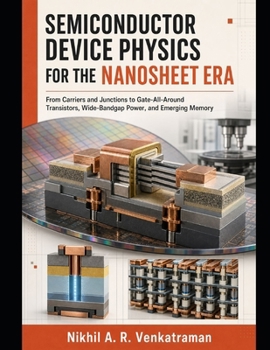
Semiconductor Device Physics for the Nanosheet Era: From Carriers and Junctions to Gate-All-Around Transistors, Wide-Bandgap Power, and Emerging Memor

Silicon transistors just changed shape. As the industry moves from FinFETs to gate-all-around nanosheets, and as electric vehicles run on silicon carbide while data centers embed spin-transfer memory, most device physics courses are still teaching a picture that stopped in 2015. Semiconductor Device Physics for the Nanosheet Era rebuilds the subject from carrier statistics and the p-n junction all the way through to the transistors, power devices, and memory cells shipping today - in one consistent notation, with every derivation shown in full.
Across 16 chapters you'll build the electrostatics of the MOS capacitor into the planar MOSFET, watch short-channel effects force the industry through FinFET and into gate-all-around nanosheets, then extend the same tools to silicon carbide and gallium nitride power devices and to MRAM, RRAM, FeFET, and phase-change memory. A running computational thread - short, runnable Python listings in every chapter - culminates in a three-chapter capstone that builds a real 1-D drift-diffusion nanosheet transistor simulator from scratch. Every chapter closes with fully worked problems and complete solutions, and current industry data (TSMC's N2 node, Samsung's GAA process, SiC's rise in EV inverters) grounds the physics in the technology actually being built.
What's InsideCarrier statistics, band structure, and transport built up rigorously from first principles (Ch. 1-2)The p-n junction, Schottky contacts, and heterojunctions, including a numerical Poisson solver reused throughout the book (Ch. 3-4)MOS electrostatics and the planar MOSFET, then the short-channel effects that forced the industry to change transistor geometry (Ch. 5-7)FinFET and gate-all-around nanosheet transistors, plus a look at what comes after nanosheet - forksheet, CFET, and 2D-channel devices (Ch. 8-10)Variability, reliability, and parasitics at advanced process nodes (Ch. 11)Silicon carbide and gallium nitride power device physics, from material fundamentals to real trench MOSFETs and HEMTs (Ch. 12-14)MRAM, RRAM, FeFET, and phase-change memory, closing with a comparative map of the whole memory landscape (Ch. 15-16)A three-chapter capstone project: a complete, self-consistent 1-D drift-diffusion nanosheet-FET simulator built incrementally in PythonFull worked examples and complete problem solutions in every chapter - not just answer keysWhy This BookThe only text that carries one consistent notation and computational framework across classical device physics, advanced-node logic, wide-bandgap power, and emerging memoryGrounded in 2025-2026 industry reality: actual node names, actual adoption data, not textbook abstractionsA genuine computational thread, not decorative code - the capstone simulator is built piece by piece, chapter by chapter, and actually runsFull derivations at graduate rigor, paired with complete worked solutions most competing texts skipCovers the FinFET-to-nanosheet transition in real depth, where older standard references stop at planar MOSFETs entirelyWho It's ForGraduate students (MS/PhD) in electrical engineering taking or reviewing a device physics sequencePracticing device engineers moving from planar or FinFET nodes into GAA nanosheet process workPower electronics engineers who need real device-physics grounding in SiC and GaN, not just circuit-level treatmentMemory technology engineers and researchers wanting MRAM/RRAM/FeFET physics tied back to the same electrostatics framework as logic devicesInstructors assembling a modern device physics course that includes what actually shipped after 2020Related Subjects
Engineering Science Science & Math Science & Scientists Science & Technology TechnologyCustomer Reviews
ThriftBooks ® and the ThriftBooks ® logo are registered trademarks of Thrift Books Global, LLC
