


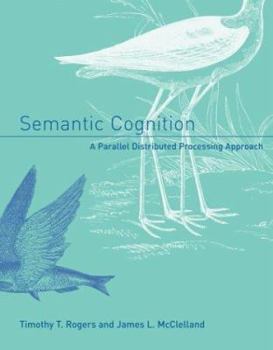
Semantic Cognition: A Prallel Distributed Processing Approach
No Customer Reviews

Select Format
Select Condition 
Book Overview
This groundbreaking monograph offers a mechanistic theory of the representation and use of semantic knowledge, integrating the strengths and overcoming many of the weaknesses of hierarchical, categorisation-based approaches, similarity-based approaches, and the approach often called theory theory. Building on earlier models by Geoff Hinton in the 1980s and David Rumelhart in the early 1990s, the authors propose that performance in semantic tasks arises through the propagation of graded signals in a system of interconnected processing units. The representations used in performing these tasks are patterns of activation across units, governed by weighted connections among them. Semantic knowledge is acquired through the gradual adjustment of the strengths of these connections in the course of day-to-day experience. The authors show how a simple computational model proposed by Rumelhart exhibits a progressive differentiation of conceptual knowledge, paralleling aspects of cognitive development seen in the work of Frank Keil and Jean Mandler. The authors extend the model to address aspects of conceptual knowledge acquisition in infancy, basic-level effects and their interaction with
Format:Hardcover
Language:English
ISBN:0262182394
ISBN13:9780262182393
Release Date:January 2004
Publisher:Bradford Books
Length:422 Pages
Weight:1.90 lbs.
Dimensions:9.0" x 1.0" x 7.3"
Customer Reviews
0 rating
Copyright © 2026 Thriftbooks.com Terms of Use
| Privacy Policy | Do Not
Sell/Share My Personal Information | Cookie Policy | Cookie Preferences | Accessibility Statement
ThriftBooks® and the ThriftBooks® logo are registered trademarks of Thrift Books Global, LLC
ThriftBooks® and the ThriftBooks® logo are registered trademarks of Thrift Books Global, LLC
