


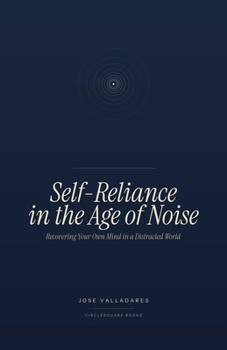
Self-Reliance in the Age of Noise

You used to know what you thought before you knew what you were supposed to think. The opinion forms before the encounter. The verdict arrives before the experience. The internal performance has begun before you've had a chance to check whether the audience is even there.
Self-Reliance in the Age of Noise is a contemplative essay collection on what it takes to recover your own mind in conditions designed to scatter it. Jose Valladares returns to Emerson's old question - how does a person stay genuinely their own? - and asks it again for an age in which the pressure on a self is no longer mostly inherited authority, but continuous, frictionless suggestion from every direction at once.
This is not a productivity book. It is not a wellness book. There are no thirty-day plans, no morning routines, no protocols, no step-by-step programs for finding yourself. There are fifteen careful chapters on:
the three kinds of noise that have crowded out the interior - informational, social, and the running performance you stage for yourselfthe difference between certainty and conviction, and why one is a feeling and the other is a stanceintuition as compressed pattern recognition, not mystical oraclesolitude as equipment, not escapeborrowed ambition, borrowed belief, borrowed wants - and the slow work of telling yours from theirswhy interior work is the precondition for real relationships, not their competitorspiritual independence in an age suspicious of both inherited religion and reflexive disbeliefbecoming quiet enough to hear yourself, without a checklistWritten in the calm, lucid register of contemporary essayists like Oliver Burkeman (Four Thousand Weeks), Alain de Botton (The Consolations of Philosophy), and Jenny Odell (How to Do Nothing), this is a book to read slowly, in small doses, when you're trying to remember what you actually think.
For readers who feel the surrounding noise but have grown skeptical of the cures the noise itself keeps recommending.
Customer Reviews
ThriftBooks ® and the ThriftBooks ® logo are registered trademarks of Thrift Books Global, LLC
