


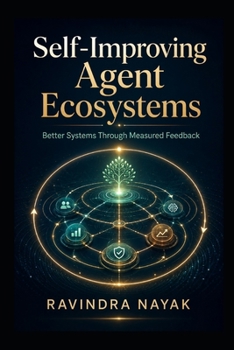
Self-Improving Agent Ecosystems: Better Systems Through Measured Feedback

What does it really mean for an AI system to get better?
A faster answer is not automatically a better answer. A higher score can hide a serious regression. A smarter agent can become less trustworthy if it learns from the wrong signal, changes the wrong layer, or expands before the evidence is strong enough.
Self-Improving Agent Ecosystems makes this difficult subject understandable from first principles. Written for readers who do not need to program or know advanced mathematics, it explains how AI agents and multi-agent systems can improve through measured feedback while keeping safety, rollback, evaluation, and human authority visible.
The book begins with a simple idea: improvement needs a direction. From there, each layer is built carefully. You will learn how to define a baseline, name a version, collect useful feedback, build evaluation sets, separate task families, use scorecards without being fooled by averages, and recognize when uncertainty should slow a decision.
Then the system becomes more real.
You will follow feedback through logs, traces, tools, human review, memory, and retrieval. You will learn how to diagnose the first meaningful divergence and decide whether the responsible change belongs in the prompt, context, retrieval layer, memory, routing, tool contract, workflow, model behavior, or evaluation process.
The book then turns improvement into an experiment. It explains hypotheses, fair comparisons, representative samples, regression tests, protected metrics, shadow testing, canary deployment, rollback triggers, and staged expansion in plain language. The goal is not to make change faster. It is to make learning more trustworthy.
As the architecture grows, the book moves into multi-agent systems: specialist agents, shared standards, local learning, global objectives, coordination cost, version lineage, ecosystem drift, and controlled adaptation. The final governance section keeps the human role explicit through goals, permissions, approvals, accountability, auditability, contestability, and clear limits on autonomy.
A hands-on Value Edition at the end turns the book into a practical thinking workshop. It includes scratch-layer revision, complexity chunking, mathematics without fear, problem-solving drills, improvement cases, experiment exercises, a rapid-reference checklist, a glossary, and practitioner worksheets.
Inside you will explore:
- AI agents and agentic AI from a systems perspective
- feedback loops, baselines, versioning, and measurable improvement
- AI evaluation, guardrails, regression testing, and rollback
- prompts, context, retrieval, memory, tools, routing, and workflows
- canary testing, protected metrics, and staged deployment
- multi-agent coordination, ecosystem drift, and version lineage
- AI governance, permissions, auditability, and human authority
- first-principles problem solving for non-technical readers
This is not a promise of uncontrolled "self-evolving" AI. It is a practical guide to understanding how adaptive systems can learn carefully, how people can judge whether a change is genuinely better, and how improvement can remain measurable, reversible, and connected to human goals.
If AI agents feel powerful but difficult to reason about, this book gives you a map.
Customer Reviews
ThriftBooks ® and the ThriftBooks ® logo are registered trademarks of Thrift Books Global, LLC
