
Skip to content
Scan a barcode
Scan
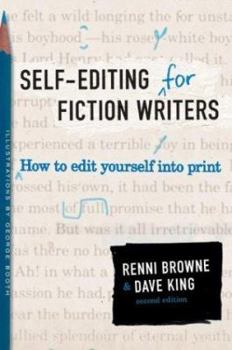
Paperback Self-Editing for Fiction Writers: How to Edit Yourself into Print Book

ISBN: 0062720465

ISBN13: 9780062720467

Self-Editing for Fiction Writers: How to Edit Yourself into Print

Select Format

Select Condition ThriftBooks Help Icon

Recommended

Format: Paperback

Condition: Good

$5.59
16 Available

Book Overview

Hundreds of books have been written on the art of writing. Here at last is a book by two professional editors to teach writers the techniques of the editing trade that turn promising manuscripts into... This description may be from another edition of this product.

Customer Reviews

4 ratings

Solid Expert Advice

I bought this on a last minute whim to fulfill a minimum for shipping and it ended up being one of the best books I've read on writing and editing, it is an excellent resource - buy it. Especially liked that content examples were sourced from a wide variety of material and all were perfect matches for the point being made in the chapter. Checklists and exercises included. This one earned a permanent parking spot on the desk.

This is required reading.

Read, follow the checklists, and complete the exercises included with each chapter. Check your versions in the Answers to Exercises section of the book. Applying the techniques within this book will help you write, not just for publication, but something that is memorable. "Authors who sell well are almost always certain to go to the highest bidder, and publishers can't reasonably afford to develop an author for a competing house." (Browne, King) The business of publishing changed, and those great editors who supported their clients and helped create stellar books are gone. The business is about making money. Therefore, "self editing is probably the only kind of editing your manuscript will ever get."Chapter 1: Show and Tell. The difference is 'to tell' is to describe what happened through a narrative summary, while 'to show' is to experience what happens. With the use of cartoon sketches, the concept is clearly revealed. Yet, pacing is important and you accomplish this by slowing the scene with narrative summary, or descriptions. Chapter 2: Characterization and Exposition. "A lot of readers seem to feel they have to give their readers a clear understanding of a new character before they can get on with their story." This stops the story. Each character is psychoanalyzed and physical details are listed. It may not seem like a list, but it is. "When you define your characters the minute you introduce them, you may be setting boundary lines..." rather than letting your characters grow.Chapter 3: Point of View. Many times a switch in POV is subtle, but it changes the perspective and makes it hard for readers to relate to the characters in the scene, story, or book. The first person POV is limiting, yet it is an excellent exercise because you can only know what "I" experience. The omniscient POV is informative, and narrative summary is an aspect. In using the third person POV, which is the compromise between the two, it is imperative to stay in one person's mind for the entire sequence, or no interior monologues by multiple characters. Chapter 4: Dialogue Mechanics. "If the dialogue doesn't work, the manuscript gets bounced." Many writers hate to use said, but it is transparent and does not require the reader to interpret the author's expression, which has taken the reader into the writer's head and away from what the characters say. Chapter 5: See How It Sounds. "The creation of character voice ... is one of the most ... challenging acts you can create as a writer." Why? Every individual is different, each has their own voice, and so must your characters. In addition, the dialogue has to be meaningful. An inane conversation does not move the story forward, it is boring, and it stops the story. Listen to your dialogue aloud. Would you say it? Chapter 6: Interior Monologue. Thoughts are constant, they interrupt our conversations by taking our attention elsewhere. We live different lives in our own minds, so do your ch

Useful for the aspiring writer of fiction

When I read this book, I kept my fluorescent highlighter nearby, and took my time with every paragraph. All the subjects are here: show and tell, characterization and exposition, point of view, interior monologue, etc. The authors are editors themselves and give advice based on their editorial careers. What I enjoyed most were the exercises at the end of each chapter. And unlike most instructional books, this one has the answers to the exercises. After reading the book, I went back over my own work and splattered the pages with red ink. Of all the writing instruction books I've read, this one has been the most useful (and interesting).

A must reference for any writer aspiring to be published.

After you've written the best story you possibly can and you're ready to send it to an agent- read this book and go back to the drawing board. Don't let the comic book illustrations fool you, this is a serious writing tool. The examples and techniques given by Renni Browne and Dave King in SELF-EDITING FOR FICTION WRITERS are priceless. It will highlight the amateur mistakes unwittingly made by many first-time authors, which are screaming red flags to agents and an acquisitions editor. Your manuscript will then gain that extra mark of professionalism. The distinction between a first draft and a story they want to see published. I found the chapter on characterization and exposition most beneficial. I learn something new about my growth as a writer and areas I can excel each time I read it. I consider it to be as valuable a reference as my dictionary or thesaurus. I hope to see more collaborative efforts from professionals in the field of editing and publishing for the benefit of writers in the future that are as easy to understand and readily applicable.

Self-Editing for Fiction Writers Mentions in Our Blog

Self-Editing for Fiction Writers in NaNoWriMo Time!
NaNoWriMo Time!
Published by Ashly Moore Sheldon • November 06, 2019

Are you an aspiring author? National Novel Writing Month, aka NaNoWriMo, is an online writing project, which began 20 years ago in 1999. The objective? Write a 50,000-word novel during the month of November? Ready, set, go!

Copyright © 2026 Thriftbooks.com Terms of Use | Privacy Policy | Do Not Sell/Share My Personal Information | Cookie Policy | Cookie Preferences | Accessibility Statement
ThriftBooks® and the ThriftBooks® logo are registered trademarks of Thrift Books Global, LLC

GoDaddy Verified and Secured