


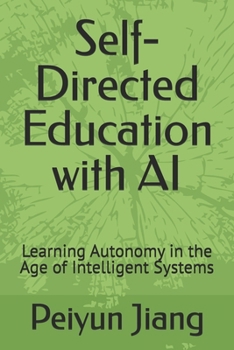
Self-Directed Education with AI: Learning Autonomy in the Age of Intelligent Systems

Education is undergoing a quiet but profound shift.
For most of modern history, learning was organized around scarcity-scarcity of information, scarcity of expertise, scarcity of access. Schools and universities emerged to manage this scarcity by transmitting knowledge, standardizing instruction, and certifying competence. For a long time, this model functioned well enough.
That world no longer exists.
Information is now abundant. Explanations are immediate. Instruction is no longer confined to classrooms, and intelligent systems can respond to questions at any hour, in any domain, with remarkable fluency. Artificial intelligence has not merely added new tools to education; it has altered the conditions under which learning occurs.
In this environment, the central educational challenge is no longer access to knowledge. It is responsibility for understanding.
Self-Directed Education with AI argues that self-directed learning is no longer an alternative educational style or a niche preference. It is becoming a necessary human capacity. When explanations are always available and assistance is constant, the ability to govern one's own learning-deciding what matters, what counts as understanding, and when effort is sufficient-can no longer be outsourced to institutions or technologies.
This book does not present AI as a teacher, nor as a shortcut to mastery. It treats AI as a cognitive companion: a powerful instrument that can support inquiry, reflection, and synthesis when used deliberately, and quietly undermine judgment when used carelessly. The difference lies not in the technology, but in the posture of the learner.
Across its chapters, the book examines:
why modern education increasingly fails to cultivate judgment and autonomy,
how self-directed learning has functioned historically and psychologically,
how AI changes the risks and responsibilities of learning,
and how individuals, families, and institutions can respond without surrendering human agency.
Rather than offering productivity hacks or step-by-step formulas, this book focuses on orientation. It asks what learning is for in a world where intelligence is abundant but understanding is not guaranteed. It insists that learning remains a human practice-one that involves uncertainty, effort, ethical responsibility, and long arcs of formation.
Self-Directed Education with AI is written for learners who sense that credentials have not delivered confidence, for educators who recognize the limits of instruction-centered teaching, and for anyone who believes that learning is not merely preparation for life, but a way of living attentively within it.
In the age of AI, education does not disappear.
It becomes personal again.
Customer Reviews
ThriftBooks ® and the ThriftBooks ® logo are registered trademarks of Thrift Books Global, LLC
