


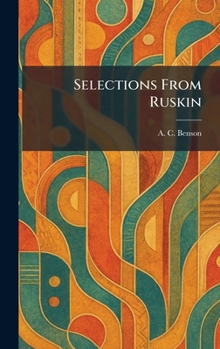
Selections From Ruskin

"Selections From Ruskin" is a curated anthology that brings together the most profound and influential writings of John Ruskin, one of the Victorian era's preeminent thinkers and critics. Edited by the scholar A. C. Benson, this collection offers a comprehensive overview of Ruskin's multifaceted genius, spanning his revolutionary art criticism, his evocative descriptions of the natural world, and his impassioned pleas for social reform.
The volume showcases Ruskin's unique ability to bridge the gap between aesthetics and ethics, demonstrating how his observations on painting and architecture often evolved into deep reflections on human character and societal responsibility. Readers will find excerpts that highlight his masterful prose style-characterized by rhythmic intensity and visual precision-as he explores topics ranging from the majesty of the Alps to the moral foundations of political economy. By selecting passages that represent the core of Ruskin's philosophy, this work provides an accessible entry point into the thoughts of a man whose ideas on conservation, craftsmanship, and the dignity of labor continue to resonate. This collection serves as an essential resource for those interested in English literature and the history of ideas, preserving the legacy of a writer who sought to teach the world how to see with both the eye and the heart.
This work has been selected by scholars as being culturally important, and is part of the knowledge base of civilization as we know it. This work was reproduced from the original artifact, and remains as true to the original work as possible. Therefore, you may see the original copyright references, library stamps (as most of these works have been housed in our most important libraries around the world), and other notations in the work.
This work is in the public domain in the United States of America, and possibly other nations. Within the United States, you may freely copy and distribute this work, as no entity (individual or corporate) has a copyright on the body of the work.
As a reproduction of a historical artifact, this work may contain missing or blurred pages, poor pictures, errant marks, etc. Scholars believe, and we concur, that this work is important enough to be preserved, reproduced, and made generally available to the public. We appreciate your support of the preservation process, and thank you for being an important part of keeping this knowledge alive and relevant.
Customer Reviews
ThriftBooks ® and the ThriftBooks ® logo are registered trademarks of Thrift Books Global, LLC
