


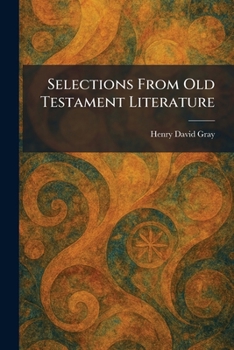
Selections From Old Testament Literature

Select Format
Select Condition 
Book Overview
"Selections From Old Testament Literature", edited by Henry David Gray, offers a curated examination of the foundational texts that comprise the Hebrew Bible. This collection approaches the Old Testament not merely as a religious document, but as a profound body of literature that has shaped Western thought and artistic expression for millennia. By organizing key passages into a cohesive anthology, the work highlights the diverse genres present within the scriptures, from the epic narratives of the Pentateuch and the lyrical beauty of the Psalms to the stark wisdom of the Proverbs and the powerful oratory of the prophets.
Designed for both students of literature and general readers, this volume provides a structured way to engage with the historical and cultural significance of these ancient writings. Gray's selections focus on the narrative power and poetic depth of the text, allowing the literary merits of the Old Testament to stand alongside its theological importance. Whether used as a scholarly resource or for personal enrichment, "Selections From Old Testament Literature" serves as an essential guide to understanding the enduring legacy and stylistic variety of one of history's most influential literary canons.
This work has been selected by scholars as being culturally important, and is part of the knowledge base of civilization as we know it. This work was reproduced from the original artifact, and remains as true to the original work as possible. Therefore, you may see the original copyright references, library stamps (as most of these works have been housed in our most important libraries around the world), and other notations in the work.
This work is in the public domain in the United States of America, and possibly other nations. Within the United States, you may freely copy and distribute this work, as no entity (individual or corporate) has a copyright on the body of the work.
As a reproduction of a historical artifact, this work may contain missing or blurred pages, poor pictures, errant marks, etc. Scholars believe, and we concur, that this work is important enough to be preserved, reproduced, and made generally available to the public. We appreciate your support of the preservation process, and thank you for being an important part of keeping this knowledge alive and relevant.
Customer Reviews
ThriftBooks ® and the ThriftBooks ® logo are registered trademarks of Thrift Books Global, LLC
