


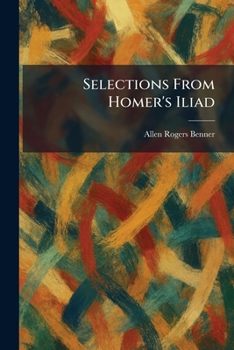
Selections From Homer's Iliad

"Selections From Homer's Iliad" offers a curated journey through one of the foundational cornerstones of Western literature. This collection, edited by scholar Allen Rogers Benner, focuses on the most pivotal and evocative passages of the epic poem, providing an accessible entry point into the monumental narrative of the Trojan War. The work captures the wrath of Achilles, the heroism of Hector, and the complex interplay between gods and mortals on the plains of Troy.
Homer's "Iliad" remains an unparalleled masterpiece of ancient Greek epic poetry, exploring universal themes of honor, glory, fate, and the devastating consequences of conflict. By distilling the original expansive text into essential highlights, these selections emphasize the lyrical beauty and the dramatic intensity of the legendary struggle. This volume is a valuable resource for students of classics and readers seeking to grasp the breadth and depth of Homeric storytelling. It bridges the gap between the ancient world and the modern reader, preserving the historical and literary significance of a work that has shaped the course of human expression for millennia.
This work has been selected by scholars as being culturally important, and is part of the knowledge base of civilization as we know it. This work was reproduced from the original artifact, and remains as true to the original work as possible. Therefore, you may see the original copyright references, library stamps (as most of these works have been housed in our most important libraries around the world), and other notations in the work.
This work is in the public domain in the United States of America, and possibly other nations. Within the United States, you may freely copy and distribute this work, as no entity (individual or corporate) has a copyright on the body of the work.
As a reproduction of a historical artifact, this work may contain missing or blurred pages, poor pictures, errant marks, etc. Scholars believe, and we concur, that this work is important enough to be preserved, reproduced, and made generally available to the public. We appreciate your support of the preservation process, and thank you for being an important part of keeping this knowledge alive and relevant.
Customer Reviews
ThriftBooks ® and the ThriftBooks ® logo are registered trademarks of Thrift Books Global, LLC
