


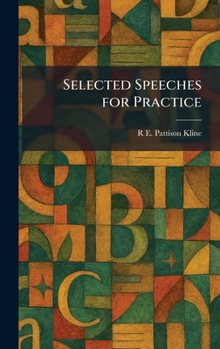
Selected Speeches for Practice

"Selected Speeches for Practice" is a comprehensive educational resource designed to assist students and aspiring orators in mastering the art of public delivery and elocution. This collection serves as a practical manual for rhetorical training, offering a wide array of speeches selected for their stylistic merit, structural clarity, and emotional resonance. The work is specifically curated to provide diverse material for oral exercise, helping readers develop the vocal range, pacing, and presence necessary for effective communication.
The volume features a variety of addresses, ranging from political orations to commemorative speeches, each chosen to illustrate specific elements of successful persuasion. By practicing these texts, the reader can refine their ability to command an audience's attention and convey complex ideas with confidence. The selections reflect the rigorous standards of early 20th-century rhetorical pedagogy, emphasizing the importance of both the written word and its oral performance.
As a tool for both academic study and personal development, "Selected Speeches for Practice" remains a valuable guide for anyone interested in the history of speech education or the timeless techniques of persuasive discourse. It provides enduring models of excellence in the English language, suitable for those seeking to enhance their professional or civic communication skills.
This work has been selected by scholars as being culturally important, and is part of the knowledge base of civilization as we know it. This work was reproduced from the original artifact, and remains as true to the original work as possible. Therefore, you may see the original copyright references, library stamps (as most of these works have been housed in our most important libraries around the world), and other notations in the work.
This work is in the public domain in the United States of America, and possibly other nations. Within the United States, you may freely copy and distribute this work, as no entity (individual or corporate) has a copyright on the body of the work.
As a reproduction of a historical artifact, this work may contain missing or blurred pages, poor pictures, errant marks, etc. Scholars believe, and we concur, that this work is important enough to be preserved, reproduced, and made generally available to the public. We appreciate your support of the preservation process, and thank you for being an important part of keeping this knowledge alive and relevant.
Related Subjects
Language ArtsCustomer Reviews
ThriftBooks® and the ThriftBooks® logo are registered trademarks of Thrift Books Global, LLC
