


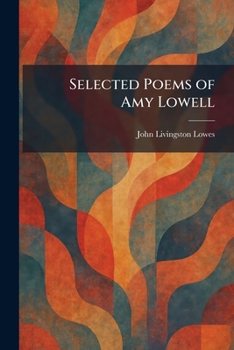
Selected Poems of Amy Lowell

"Selected Poems of Amy Lowell" offers a definitive exploration of the work of one of the most influential figures in early twentieth-century American literature. Amy Lowell, a leader of the Imagist movement and a posthumous recipient of the Pulitzer Prize for Poetry, was known for her vivid imagery and her pioneering use of "polyphonic prose" and free verse.
This collection, curated by John Livingston Lowes, brings together a wide range of Lowell's most significant pieces. The volume showcases her technical mastery and her ability to evoke powerful sensory experiences through language. From delicate, brief lyrics to sweeping historical narratives, the poems included here reflect the breadth of her intellectual curiosity and her rebellious spirit against traditional Victorian poetic structures.
Readers will find representative works from her major volumes, illustrating her evolution as an artist and her contribution to the Modernist movement. "Selected Poems of Amy Lowell" remains an essential resource for those interested in the development of modern poetry and the legacy of a woman who challenged the literary status quo of her time.
This work has been selected by scholars as being culturally important, and is part of the knowledge base of civilization as we know it. This work was reproduced from the original artifact, and remains as true to the original work as possible. Therefore, you may see the original copyright references, library stamps (as most of these works have been housed in our most important libraries around the world), and other notations in the work.
This work is in the public domain in the United States of America, and possibly other nations. Within the United States, you may freely copy and distribute this work, as no entity (individual or corporate) has a copyright on the body of the work.
As a reproduction of a historical artifact, this work may contain missing or blurred pages, poor pictures, errant marks, etc. Scholars believe, and we concur, that this work is important enough to be preserved, reproduced, and made generally available to the public. We appreciate your support of the preservation process, and thank you for being an important part of keeping this knowledge alive and relevant.
Customer Reviews
ThriftBooks ® and the ThriftBooks ® logo are registered trademarks of Thrift Books Global, LLC
