


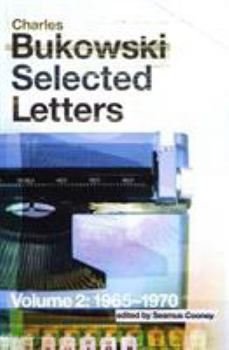
Selected Letters 1965-1970


Select Format
Select Condition 
Book Overview
I wrote letters to many in those days ...it was rather my way of screaming from my cage.' The 1960's saw Charles Bukowski struggle for recognition and slowly emerge as a unique, talented and prolific... This description may be from another edition of this product.
Format:Paperback
Language:English
ISBN:0753509369
ISBN13:9780753509364
Release Date:January 1
Publisher:Virgin Pub
Weight:0.56 lbs.
Dimensions:7.6" x 0.8" x 5.0"
Customer Reviews
1 rating
I'll die in silence, and that matters, too . . .
Published by Thriftbooks.com User , 17 years ago
In lieu of some form of analysis of Bukowski's letters--something he would have hated--I must only say that he was what he was. Of course, this implies that not all of us are. Much in the same way that a man who knows that he knows nothing is ahead of the curve, Bukowski was a drunk in the corner, alone by choice, quiet by nature, and more emotion than rationale. This was all on purpose, yet not preconceived or preconstructed. Buk didn't try to embrace the way he was, nor did he try to change it. He just tried to deal with it, which is what everyone should be doing anyways. He has no desire to make a point of waxing on literary theory and narrative craft and other "writer" things he speaks of with mostly distaste. While he does speak of creation and its guts, he often does so in a flippant way that makes it sound is if those speaking of craft and literature are wasting their time: "it's not excellence we want, it's a kind of going-on, a clown's gesture. it took some deciding to come to this. I think we are all too careful. **** reputation. if I have a reputation it's only the dirty work of others. I have a right to go on. nobody has the rights to rope and bind me. **** `em." If everyone else writes stories and poems, Bukowski wrote photographs: not every one is a keeper, but if you take 20 pictures a day, you're going to wind up catching genius by the wings. Oates and Steve King have done it the same way, only on purpose. Buk just did it because he did it, which is just as good of an explanation as any. The whole collection reads like any other Bukowski you've read: nihilistic rants in the truest sense, because nothing is real and everything is real and **** everything and everything is beautiful. Everything is happening at all times, but not in the beat/hippie Earthless/Mindless floating sort of ideology that he avoided throughout that entire counterculture movement. He was his own counterculture, and for anything to be truly alternative, it must also be its own of whatever it may be: "I guess that most of these boys are working centuries ahead, thinking how it might look in an English class, 2067 a.d., but they might get fooled -- there might not be an English class then, or if there is those left might be able to sniff the strain of careful begging. I'm here now and the electric light is on over this typewriter and that's all I know. if some w**** uncrosses her legs and has an orgasm 100 years from now over my stuff my bones won't light with neon. not where they are going to dump me anyhow." The middle seemed to crawl a bit, and while it becomes much of the same, it shows how closely Bukowski was connected to his work. The writing suffered when he suffered. As his career starts to pick up in 1969, the writing came much easier. This means the reading of the writing comes much easier, as well. While I'm almost sure I'd hate him if were ever to meet, he was free and kept few people close to him as a result. He is a self-described "one-man revo
Copyright © 2026 Thriftbooks.com
Terms of Use | Privacy Policy | Do Not Sell/Share My Personal Information | Cookie Policy | Cookie Preferences | Accessibility Statement
ThriftBooks ® and the ThriftBooks ® logo are registered trademarks of Thrift Books Global, LLC
ThriftBooks ® and the ThriftBooks ® logo are registered trademarks of Thrift Books Global, LLC
