


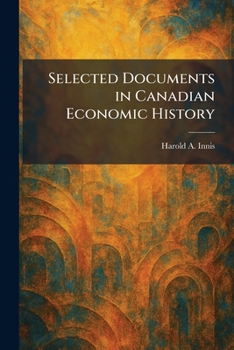
Selected Documents in Canadian Economic History

"Selected Documents in Canadian Economic History" is an authoritative collection of primary source materials curated to illustrate the foundational economic forces that shaped Canada. Compiled by the renowned scholar Harold A. Innis, this work serves as an essential reference for understanding the complex transition from a colonial resource-based economy to a developing industrial nation.
The documents contained within this volume provide a detailed look at the pivotal industries that drove Canadian growth, including the fur trade, timber, fisheries, and early agricultural efforts. Through official records, correspondence, and contemporary reports, the work highlights the logistical challenges of the vast Canadian landscape and the social structures that emerged from early mercantile activities. It emphasizes the critical relationship between geography, transport, and economic policy, laying the groundwork for what would become known as the staples thesis in Canadian historiography.
This collection is a vital resource for students of economic history and North American studies, offering a direct window into the material development of the country. By presenting these historical records, "Selected Documents in Canadian Economic History" remains a cornerstone for any serious study of the economic underpinnings of Canadian society and its place in the global market.
This work has been selected by scholars as being culturally important, and is part of the knowledge base of civilization as we know it. This work was reproduced from the original artifact, and remains as true to the original work as possible. Therefore, you may see the original copyright references, library stamps (as most of these works have been housed in our most important libraries around the world), and other notations in the work.
This work is in the public domain in the United States of America, and possibly other nations. Within the United States, you may freely copy and distribute this work, as no entity (individual or corporate) has a copyright on the body of the work.
As a reproduction of a historical artifact, this work may contain missing or blurred pages, poor pictures, errant marks, etc. Scholars believe, and we concur, that this work is important enough to be preserved, reproduced, and made generally available to the public. We appreciate your support of the preservation process, and thank you for being an important part of keeping this knowledge alive and relevant.
Customer Reviews
ThriftBooks ® and the ThriftBooks ® logo are registered trademarks of Thrift Books Global, LLC
