


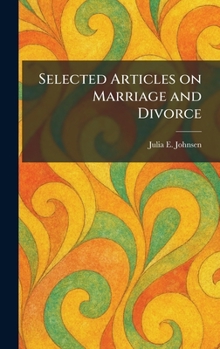
Selected Articles on Marriage and Divorce

"Selected Articles on Marriage and Divorce" is a comprehensive compilation of perspectives and debates surrounding the legal and social aspects of domestic unions during a pivotal era of social change. Compiled by Julia E. Johnsen, this work serves as an essential resource for understanding the historical evolution of family law and societal norms in the early twentieth century. The volume brings together diverse arguments from legislators, sociologists, and legal scholars, examining the complexities of marriage contracts and the growing calls for divorce reform.
Through a curated selection of essays and reports, the book explores the tension between traditional institutions and the modernizing forces of society. It addresses critical questions of state versus federal control over marriage laws, the ethical implications of marital dissolution, and the impact of legal changes on the family unit. "Selected Articles on Marriage and Divorce" provides a vital snapshot of the intellectual and social landscape of the 1920s, offering researchers and students deep insights into the historical foundations of modern family legislation. This collection remains a significant historical document for those interested in the history of law, sociology, and gender studies.
This work has been selected by scholars as being culturally important, and is part of the knowledge base of civilization as we know it. This work was reproduced from the original artifact, and remains as true to the original work as possible. Therefore, you may see the original copyright references, library stamps (as most of these works have been housed in our most important libraries around the world), and other notations in the work.
This work is in the public domain in the United States of America, and possibly other nations. Within the United States, you may freely copy and distribute this work, as no entity (individual or corporate) has a copyright on the body of the work.
As a reproduction of a historical artifact, this work may contain missing or blurred pages, poor pictures, errant marks, etc. Scholars believe, and we concur, that this work is important enough to be preserved, reproduced, and made generally available to the public. We appreciate your support of the preservation process, and thank you for being an important part of keeping this knowledge alive and relevant.
Customer Reviews
ThriftBooks ® and the ThriftBooks ® logo are registered trademarks of Thrift Books Global, LLC
