


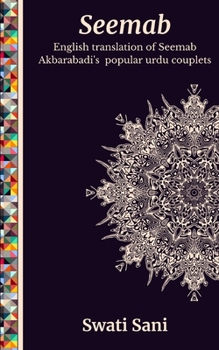
Seemab: English Translation of Seemab Akbarabadi's popular Urdu couplets
No Customer Reviews

Seemab started writing Urdu Ghazals at a time when the Urdu Ghazal was evolving. New themes and newer compositions were finding their way into this traditional art form, and Seemab played a vital role in its evolution. Along with ghazals, Seemab, by now, had also started writing Nazms. He was paying more attention to his nazmiya shayari, as it gave him more scope to present his ideas. Seemab's body of work is tremendous. His poetry encompasses a vast range of emotions, and ideas. His manner of versification (tarz-e-taghaful) is simple and informal and is very appealing. His poetry also has an eloquence and appropriate use of idioms and phrases, all of which entices the reader. Umr-e-daraz maang ke layi thi chaar din do aarzoo mein kat gaye do intezaar mein For a long life I begged, and four days I could negotiate two days of which I spent in pining, and two in wait Seemab was a God-fearing man and believed in the goodness of mankind. In his poetry, one identifies a distinct Sufi style. While most Sufi poets of that era were disciples (murid) of a spiritual teacher (murshid) and wrote poetry in praise of their murshid, Seemab's Sufism addressed the almighty directly, especially in his Nazmia Shayari. In his lifetime Seemab wrote and published about 300 books. Some more were published after his death. The magazine, Shair, that he started in 1930 is still being published by his grandsons, making it the oldest Urdu literary magazine in publication. One can easily say that Seemab is one of the foremost poets from the pre-modern era of Urdu poetry.
Format:Paperback
Language:English
ISBN:B0BRDCPTB2
ISBN13:9798372054516
Release Date:December 2022
Publisher:Independently Published
Length:94 Pages
Weight:0.24 lbs.
Dimensions:0.2" x 5.0" x 8.0"
Customer Reviews
0 rating
Copyright © 2025 Thriftbooks.com
Terms of Use | Privacy Policy | Do Not Sell/Share My Personal Information | Cookie Policy | Cookie Preferences | Accessibility Statement
ThriftBooks ® and the ThriftBooks ® logo are registered trademarks of Thrift Books Global, LLC
ThriftBooks ® and the ThriftBooks ® logo are registered trademarks of Thrift Books Global, LLC
