


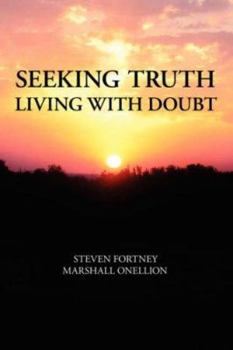
Seeking Truth: Living with Doubt

Exploring the intersection of art, science and religion, "Seeking Truth: Living with Doubt" considers that all three are paths to the same end. Attacking not only the unyielding smugness of... This description may be from another edition of this product.
Format:Paperback
Language:English
ISBN:1434318729
ISBN13:9781434318725
Release Date:June 2007
Publisher:Authorhouse
Length:316 Pages
Weight:1.15 lbs.
Dimensions:0.7" x 6.0" x 9.0"
Customer Reviews
5 ratings
Reviewed by John D. Merrill
Published by Thriftbooks.com User , 18 years ago
In true academic form, Fortney and Onellion compare and contrast three major routes that people use to understand the world: Religion, Science, and the Arts. With religion they focus on the dogmatic western religions meaning Christianity, Judaism, and Islam. Those religions are seen as old and invalid ways to find truth and real understanding. On the other hand Eastern and mystic style religions which focus on self-awareness are praised for their expansion of the human mind and their ability to help lead individuals towards an enlightened understanding. As for the sciences and art, the book focuses less on the specifics of their subgroups and doctrine but generalizes the similar goals of finding meaning or truth as oppose to discovering simple facts. The themed chapters of Seeking Truth Living With Doubt begin by breaking up the history and basis of the different ways to seek truth and what is the guiding principle behind their goals. They continue on to the areas where they all search for truth, i.e. mind and body, the world, and consciousness. The book concludes with a look at the social impact and the outlook for the future for these paths to understanding. My one caution of the book is to those members of those aforementioned religions who lead a faith based life. To discount dogmatic religions as a valid path to understanding contradicts the open minded point of the book, to not discount different ways to understand the world. Not to say that Seeking Truth Living With Doubt discounts the idea of absolute truth but perpetuates the belief that we have not yet found it. This book is praise to independence of thought and those who base their life around their own abilities and strive to improve their lives and minds with their own wisdom. This book is meant for students especially for the younger crowd, this book reads much like option reading for an undergrad Religion class. It asks more questions than it answers. I would recommend this book to anyone who believes that the human heart, not a doctrine, contains the path to understanding and ultimate truth.
Doubt and Insight
Published by Thriftbooks.com User , 18 years ago
Bertrand Russell says in one his essays that the capacity for doubt is one of the traits he most admires in human beings. For a person like me who was taught in Catholic schools that faith is a virtue and doubt is a sin, that sentence came as a revelation. I read it 35 years ago, and it has retained its resonance through the years - my favorite apostle has always been doubting Thomas. Seeking Truth, Living with Doubt, by Fortney and Onellion, is the first book I have read that takes doubt as its single central theme. There are certainly other works that come close, Popper's The Open Society, for example, and Hoffer's The True Believer. (In fact this book is the obverse of The True Believer, in a way.) But Seeking Truth, Living with Doubt is the first book I have seen that makes the argument, as broadly as possible, that doubt is good, that all authentic efforts to find truth will always involve doubt, and that doubt is the characteristic that, across religion, science, and art, is the only clear signature of honest striving for insight into the world. Following from this is the idea that ethical behavior is connected with doubt: the humility associated with doubt spills over into right conduct, while the arrogance associated with faith leads to an indifference to the sufferings of others. The role of doubt in science is not that complicated, it seems to me. Knowledge in science may be thought of as three concentric circles with doubt increasing as we go out from the center. The innermost circle contains those truths of which we are quite certain: the sun will come up tomorrow, natural selection drives evolution. Just beyond that are the topics of current research. It contains not certain truths but hypotheses: dark matter consists of weakly interacting massive particles, cloud formation will significantly slow global warming. Varying degrees of doubt attach to all such hypotheses. In the outer circle is ignorance: what happened before the Big Bang?, what is the organism that would result from an arbitrary base pair sequence of DNA? We just have no idea. The point that Fortney and Onellion rightly make is that working scientists (such as Onellion) inhabit the intermediate zone and thus live constantly with doubt. In this way scientific discovery is intimately and necessarily associated with doubt, and all great scientists acknowledge this. The role of doubt in religion is of course much more contentious. If truth is revealed by God, not discovered, then what use has doubt once the revelation has been recognized by the individual? The answer to this question in Christianity has been an uneasy and often-violated truce between reason and faith since the 17th century. One of the best parts of Living with Doubt is the description of the corresponding situations in Judaism, where doubt and flexibilty in faith are more tolerated than in Christianity, and in Islam, where doubt is less tolerated. The authors point o
Truthiness, with Doubt
Published by Thriftbooks.com User , 18 years ago
All my life, I have sought truth and lived with doubt, so it was nice to know that, finally, a definitive volume has been written on this issue. I have found this book to be useful clarifying very large topics that, for me, were previously largely unexplored. This is an eye opening tome. Each section sends me off on thoughtful journies; it is no small wonder it has taken me some time to read! Highly recommended for independent and critical thinkers and should be gifted to those who are not.
Reasons to Think
Published by Thriftbooks.com User , 18 years ago
***It took me over a month to read completely through this thought-provoking volume; each chapter generated plenty to ponder on before continuing. Am comforted to realize that many others have had the same growing doubts about hierarchical religions as I experienced during my decades of maturing. Before 'Seeking Truth', I recently read '1491', a compilation of many thoughts, including about religions, of Pre-Historical South America. It got me wondering why and how religions have been so important throughout our existence. Now have just finished 'The Faiths of Our Founding Fathers' which I understood better after I had read 'Seeking Truth'. One of the 'Seeking Truth' authors calls himself an 'Agnostic' because he doesn't know enough to be an 'Atheist'. Me too. ***Brought up to attend 'Services' every Sunday; and to not argue (= 'Discuss' to many males now-a-days) about Religion or Politics, it took me several decades of private pondering to wonder about the 'truths' I had been directed to accept blindly. If 'Seeking Truth' had been available to me then, it would have made much easier the route to my present awareness of forces shaping our world. "Seeking Truth' chapters led me into a thorough review and some new education for me, of many factors which have been and still are involved in real relationships among peoples. *** My re-action to "Seeking Truth, Living in Doubt" is very favorable. It helps me understand, and to appreciate, the divergent ideas of mankind. Hopefully, I'll be able to better carryout my little part in how we all get along with each other. Certainly worth the effort.
A book with a new perspective
Published by Thriftbooks.com User , 18 years ago
Among the set of recent books critically assessing religion from a modern scientific perspective, Seeking Truth: Living with Doubt provides a much needed, larger perspective. I enjoyed and very much recommend it. I believe that the book will be similarly enjoyed by, and will challenge, all concerned with such matters - from the atheist to the fundamentalist. Whereas Seeking Truth is unflinching in critiquing the weakness, scientific and philosophical, of the certainty professed by religious fundamentalism, it equally well describes the limitations of science and the role of mystical experiences. Three paths to truth-seeking are described: the three Levantine monotheistic religions, science, and mysticism (broadly defined). Each is discussed in a broad context: historical, literary, philosophical. The result is a wonderful approach to the larger questions we face. Perhaps such a book required the co-authorship of a professional scientist (physicist) and humanist (English teacher/writer). This partnership has spun a book that reads as if from one mind, but contains expertise not easily found in one author.
Copyright © 2026 Thriftbooks.com Terms of Use
| Privacy Policy | Do Not
Sell/Share My Personal Information | Cookie Policy | Cookie Preferences | Accessibility Statement
ThriftBooks® and the ThriftBooks® logo are registered trademarks of Thrift Books Global, LLC
ThriftBooks® and the ThriftBooks® logo are registered trademarks of Thrift Books Global, LLC
