


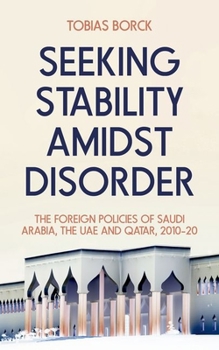
Seeking Stability Amidst Disorder: The Foreign Policies of Saudi Arabia, the Uae and Qatar, 2010-20
No Customer Reviews

The 2010s were a decade of transformation and conflict in the Middle East, bookended by the Arab Uprisings and the coronavirus pandemic. Throughout this time, Saudi Arabia, the UAE and Qatar--the three Arab states with the most ambitious regional policies--declared stability to be their main objective. Yet, rather than being a common denominator, this seemingly shared goal in fact obscured differences between their often-competing agendas. These three Gulf monarchies all agreed that the Middle East had descended into unprecedented and dangerous instability following the Arab Uprisings. But their assessments diverged on what characterized and drove the unrest. This led each country to formulate different--and at times contradictory--views of how politics should be organized in and between states in the region, and what role external powers should play to build a stable new order. With no universally accepted definition of stability, this book develops an original analytical framework linking this concept to that of order, and provides a useful lens through which to understand foreign policy in the Gulf. While governments often frame their relations with other states by evoking a joint commitment to stability, Tobias Borck shows that this does not, in itself, imply strategic alignment.
Format:Hardcover
Language:English
ISBN:0197767788
ISBN13:9780197767788
Release Date:January 2024
Publisher:Oxford University Press
Length:315 Pages
Weight:1.10 lbs.
Dimensions:1.8" x 5.7" x 8.3"
Customer Reviews
0 rating
Copyright © 2026 Thriftbooks.com
Terms of Use | Privacy Policy | Do Not Sell/Share My Personal Information | Cookie Policy | Cookie Preferences | Accessibility Statement
ThriftBooks ® and the ThriftBooks ® logo are registered trademarks of Thrift Books Global, LLC
ThriftBooks ® and the ThriftBooks ® logo are registered trademarks of Thrift Books Global, LLC
