


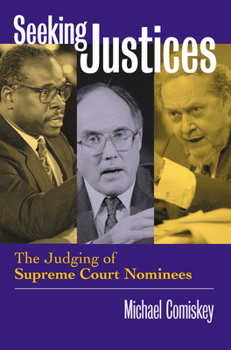
Seeking Justices: The Judging of Supreme Court Nominees

Select Format
Select Condition 
Book Overview
In the long shadows cast by the Robert Bork and Clarence Thomas nominations, Supreme Court confirmations remain highly contentious and controversial. This is due in part to the Senate's increasing reliance upon a much lengthier, much more public, and occasionally raucous confirmation process--in an effort to curb the potential excesses of executive power created by presidents seeking greater control over the Court's ideological composition. Michael Comiskey offers the most comprehensive, systematic, and optimistic analysis of that process to date. Arguing that the process works well and therefore should not be significantly altered, Comiskey convincingly counters those critics who view highly contentious confirmation proceedings as the norm. Senators have every right and a real obligation, he contends, to scrutinize the nominees' constitutional philosophies. He further argues that the media coverage of the Senate's deliberations has worked to improve the level of such scrutiny and that recent presidents have neither exerted excessive influence on the appointment process nor created a politically extreme Court. He also examines the ongoing concern over presidential efforts to pack the court, concluding that stacking the ideological deck is unlikely. As an exception to the rule, Comiskey analyzes in depth the Thomas confirmation to explain why it was an aberration, offering the most detailed account yet of Thomas's pre-judicial professional and political activities. He argues that the Senate Judiciary Committee abdicated its responsibilities out of deference to Thomas's race. Another of the book's unique features is Comiskey's reassessment of the reputations of twentieth-century Supreme Court justices. Based on a survey of nearly 300 scholars in constitutional law and politics, it shows that the modern confirmation process continues to fill Court vacancies with jurists as capable as those of earlier eras. We have now seen the longest period without a turnover on the Court since the early nineteenth century, making inevitable the appointment of several new justices following the 2004 presidential election. Thus, the timing of the publication of Seeking Justices could not be more propitious.
Format:Paperback
Language:English
ISBN:0700613471
ISBN13:9780700613472
Release Date:October 2004
Publisher:University Press of Kansas
Length:296 Pages
Weight:0.60 lbs.
Dimensions:1.0" x 6.1" x 9.0"
Customer Reviews
1 rating
Another Look at Supreme Court Nominations
Published by Thriftbooks.com User , 19 years ago
This is one of a slew of recent books focusing upon the nomination process for Supreme Court Justices. The author, an associate professor of political science, argues that the current process, while not perfect, is neither as ineffectual as some critics allege or as destructive of judicial independence as other observers contend. To assess the current process, the author discusses the history of the selection process; the intended constitutional role of the Senate in the process (i.e., is ideology fair game?); and the record regarding confirmation hearings. The author disputes that the process is overpoliticized, which he attributes to the inaccurate images of the Bork and Thomas hearings. Rather, the key determinant is the professional qualifications of the nominee, his ethical views, and whether his constitutional philosophy is in the mainstream. The book contains the results of a survey the author conducted of experts that concluded there has not been an erosion in the quality of recent Justices. A most interesting chapter on the Thomas nomination is included, which was a mess largely due to an indecisive Judiciary Committee handling of the Anita Hill issue. The author also discusses whether nominees are scrutinized too much, or not enough. A solid discussion of the Rehnquist court is employed to argue that a ideologically conservative court does not necessarily go off in bizarre directions, but remains largely in the mainstream. In short, for the most part, the current selection process the author contends is in fairly robust good health. The analysis is supported by 58 pages of helpful notes and an extremely valuable bibliography of sources on this issue. While perhaps a bit overly sanguine about the current process, nonetheless a thoughtful discussion of this vital issue.
Copyright © 2026 Thriftbooks.com Terms of Use
| Privacy Policy | Do Not
Sell/Share My Personal Information | Cookie Policy | Cookie Preferences | Accessibility Statement
ThriftBooks® and the ThriftBooks® logo are registered trademarks of Thrift Books Global, LLC
ThriftBooks® and the ThriftBooks® logo are registered trademarks of Thrift Books Global, LLC
