


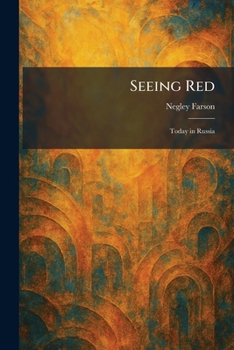
Seeing Red: Today in Russia

Select Format
Select Condition 
Book Overview
"Seeing Red; Today in Russia" is a vivid and penetrating firsthand account of life in the Soviet Union during the pivotal years following the revolution. Written by the acclaimed journalist Negley Farson, this work captures the stark realities of a nation undergoing a radical social and political transformation. Farson travels through the heart of the USSR, offering readers an unfiltered look at the Bolshevik experiment in its early maturity. From the bustling streets of Moscow to the industrial projects and rural landscapes, the narrative provides a unique window into the daily lives, struggles, and aspirations of the Russian people under Communist rule.
The book excels as both a travelogue and a piece of investigative journalism, balancing personal observations with sharp political analysis. Farson documents the tension between revolutionary ideals and the practical difficulties of the new regime, detailing the atmosphere of surveillance, the fervor of the youth, and the shifting social structures of the time. As a historical document, "Seeing Red; Today in Russia" remains an essential resource for understanding the complexities of the Soviet state and the Western perspective on its rise during the interwar period. It is a compelling exploration of a world behind the burgeoning Iron Curtain, rendered with the keen eye of a seasoned observer.
This work has been selected by scholars as being culturally important, and is part of the knowledge base of civilization as we know it. This work was reproduced from the original artifact, and remains as true to the original work as possible. Therefore, you may see the original copyright references, library stamps (as most of these works have been housed in our most important libraries around the world), and other notations in the work.
This work is in the public domain in the United States of America, and possibly other nations. Within the United States, you may freely copy and distribute this work, as no entity (individual or corporate) has a copyright on the body of the work.
As a reproduction of a historical artifact, this work may contain missing or blurred pages, poor pictures, errant marks, etc. Scholars believe, and we concur, that this work is important enough to be preserved, reproduced, and made generally available to the public. We appreciate your support of the preservation process, and thank you for being an important part of keeping this knowledge alive and relevant.
Customer Reviews
ThriftBooks ® and the ThriftBooks ® logo are registered trademarks of Thrift Books Global, LLC
