


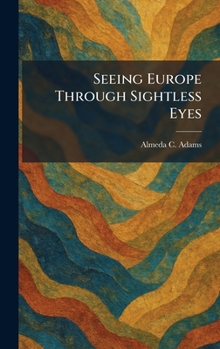
Seeing Europe Through Sightless Eyes

"Seeing Europe Through Sightless Eyes" is a remarkable travel memoir that offers a unique perspective on the European continent during the early 20th century. Written by Almeda C. Adams, a musician and educator who lost her sight in infancy, this work chronicles her journey through the cultural heart of Europe, capturing the essence of landscapes, people, and historical sites through senses beyond sight. Rather than focusing on visual grandeur, Adams emphasizes the auditory, tactile, and emotional textures of her surroundings, providing a rich and evocative account of cities and landmarks.
The narrative follows her travels through iconic destinations, offering insightful observations on music, art history, and local customs. Adams's prose is characterized by a deep intellectual curiosity and a profound appreciation for the human spirit. By sharing her experiences, she challenges conventional notions of travel and observation, demonstrating that the beauty of a culture can be deeply felt and understood without visual confirmation. "Seeing Europe Through Sightless Eyes" stands as an inspiring testament to the power of perception and the enduring allure of the Grand Tour tradition, making it a significant contribution to both travel literature and disability studies.
This work has been selected by scholars as being culturally important, and is part of the knowledge base of civilization as we know it. This work was reproduced from the original artifact, and remains as true to the original work as possible. Therefore, you may see the original copyright references, library stamps (as most of these works have been housed in our most important libraries around the world), and other notations in the work.
This work is in the public domain in the United States of America, and possibly other nations. Within the United States, you may freely copy and distribute this work, as no entity (individual or corporate) has a copyright on the body of the work.
As a reproduction of a historical artifact, this work may contain missing or blurred pages, poor pictures, errant marks, etc. Scholars believe, and we concur, that this work is important enough to be preserved, reproduced, and made generally available to the public. We appreciate your support of the preservation process, and thank you for being an important part of keeping this knowledge alive and relevant.
Customer Reviews
ThriftBooks ® and the ThriftBooks ® logo are registered trademarks of Thrift Books Global, LLC
