


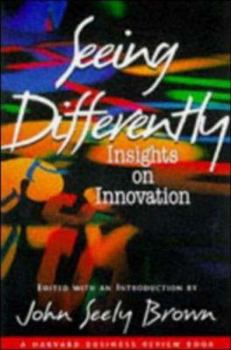
Seeing Differently: Insights on Innovation

Presents a collection of Harvard Business Reviews articles on how innovation occurs differently in organizational structures, with modern technological tools and global perspectives. This book has a broad reach, from relatively technical articles to wide-ranging pieces on strategy, which provides an integrated perspective on innovation.
Format:Hardcover
Language:English
ISBN:0875847552
ISBN13:9780875847559
Release Date:April 1997
Publisher:Harvard Business Review Press
Length:245 Pages
Weight:1.30 lbs.
Dimensions:9.8" x 1.0" x 6.5"
Customer Reviews
2 ratings
A well-chosen and valuable collection
Published by Thriftbooks.com User , 21 years ago
The value of a book of reprints mined from HBR's rich archive depends on the quality of selection by the miner. This is the best such anthology I have seen, with an excellent introduction which deserves very careful reading. To quote an early paragraph: "To do things differently, we must learn to see things differently. Seeing differently means learning to question the conceptual lenses through which we view and frame the world, our businesses, our core competencies, our competitive advantage, and our business models... If there is anything actually coming into focus today, it is the realization that we need to question much of what we think we know about how to conduct commerce, including marketing, distribution, service and the notion of competition itself. Hardest of all, we need to be able to think about changing the architecture of our revenue streams, that is, the way we make money." Also in the introduction, the author/editor introduces a powerful framework for thinking about innovation opportunities, which he calls QTL4, or Quality through Linking to the world; Listening through those linkages; Learning and reflecting through those listenings; and then Leading. He has applied this framework to selection of the articles for the book. The opening article is W. Brian Arthur's Increasing Returns and the New World of Business. It challenges one of the most fundamental tenets of classical economics, 'the assumption of diminishing returns: products or companies that get ahead in a market eventually run into limitations, so that a predictable equilibrium of prices and market shares is reached'. He argues that while this still applies in large measure to the bulk-processing economy, increasing returns, 'the tendency for that which is ahead to get further ahead, for that which loses advantage to lose further advantage' tends to reign in the newer part of the economy, the knowledge-based industries. This has enormous implications for business practice and for national policy. The two worlds of bulk processing and knowledge have different economics, operating side by side. The article works through the implications of operating in the different economies and for those organisations that have to operate simultaneously in both. It is hugely important that not only business people but also politicians and national policy makers understand its implications.
Great anthology of important ideas in strategy
Published by Thriftbooks.com User , 26 years ago
John Seely Brown has done us a big favor: he weeded through the business literature, picked a few authors that really help us "see differently," found works that describe their ideas in tight little packages, and put it all in one book. JSB's own framing comments are also valuable. Selected highlights: Brian Arthur on increasing returns, Gary Hamel's Strategy as Revolution, Morris and Ferguson on the power of platforms, Brandenburger and Nalebuff on Game Theory for strategy, sections on competitive advantage and managing innovation. I'm having my interaction design students read this, to add to their palette of points of view.
Copyright © 2026 Thriftbooks.com Terms of Use
| Privacy Policy | Do Not
Sell/Share My Personal Information | Cookie Policy | Cookie Preferences | Accessibility Statement
ThriftBooks® and the ThriftBooks® logo are registered trademarks of Thrift Books Global, LLC
ThriftBooks® and the ThriftBooks® logo are registered trademarks of Thrift Books Global, LLC
