


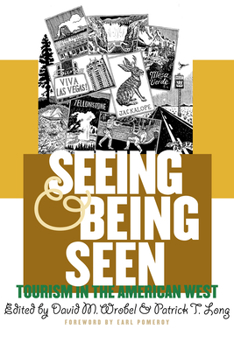
Seeing and Being Seen: Tourism in the American West


Select Format
Select Condition 
Book Overview
You can see them cruising for Indian art in Santa Fe, waiting for Old Faithful at Yellowstone, or pausing for shrimp cocktails on San Francisco's Fisherman's Wharf. The American West attracts vacationers of every stripe, who comb its varied landscapes for the ultimate trip. And for better or worse, those who come to see this multifaceted region have changed what they have come to see. Seeing and Being Seen explores the history of tourism in the American West and examines its effects on both the tourists and the places and people they visit. Scholars from the humanities, social sciences, and business-Patricia Nelson Limerick, Hal Rothman, and others-join government and National Park Service professionals to investigate the dilemmas that tourism poses for western communities, from economic and environmental questions to cultural change. The selections are organized around three broad topics: scholarly perceptions of tourism, tourists, and those toured upon; tourism in its historical context, including an assessment of its cultural impact on communities and on tourists themselves; and the history and impact of tourism on the West's national parks, with particular emphasis on efforts to maintain the delicate balance between natural preservation and public enjoyment. These essays cover the span of tourism history, from early-twentieth-century "See America First" campaigns to the problematic place of automobiles in national parks today. They also pay special attention to policy choices that the growth of tourism sometimes forces on communities, as towns try to bounce back from failed economies by capitalizing on an "Old West" image--or even, in the case of Kellogg, Idaho, "Old Bavarian." In response, the authors offer suggestions by which communities can begin to make rational choices about the role and place of tourism in their lives. Seeing and Being Seen is enlightening--and necessary--reading for scholars, policy makers, residents of the West, and even tourists themselves.
Format:Paperback
Language:English
ISBN:0700610839
ISBN13:9780700610839
Release Date:June 2001
Publisher:University Press of Kansas
Length:352 Pages
Weight:1.15 lbs.
Dimensions:0.8" x 6.0" x 9.0"
Customer Reviews
1 rating
Leisure rhymes with pleasure
Published by Thriftbooks.com User , 25 years ago
From Custer to Kerouac to Kaczynski, tourists in the West have left their mark ... and in many ways, the West has left its own indelible mark on them -- just ask Custer. In 150 years of travel across the Big Empty (as pioneers called the Intermountain West) a few have stayed, but all began as passersby. Who are they and why do they come? Why do we want them to come? Where do they go? How can we make them spend more money? Why do we make fun of them? Those are just some of the questions asked and answered in a new anthology nurtured by the University of Colorado's Center of the American West."Seeing and Being Seen" explores the history of tourism in the American West, and examines its effect on both the tourists and the people and places they visit. Essayists from National Park Service historian David Louter to novelist Rudolfo Anaya ponder the various dilemmas posed by tourism for western communities, from economic and environmental questions to cultural change.The book explains how some towns, such as Trinidad, Colo., have been reluctant to embrace tourism for fear of losing their culture, while others, like Burlington, Colo., look for ways to control -- and profit from -- the exploitation of local history and culture."Seeing and Being Seen" sprouted from a tourism colloquium sponsored by CU's Center for the New West in 1997. It is a good exploration of the industry by people whose job it is to analyze such things.
Copyright © 2026 Thriftbooks.com
Terms of Use | Privacy Policy | Do Not Sell/Share My Personal Information | Cookie Policy | Cookie Preferences | Accessibility Statement
ThriftBooks ® and the ThriftBooks ® logo are registered trademarks of Thrift Books Global, LLC
ThriftBooks ® and the ThriftBooks ® logo are registered trademarks of Thrift Books Global, LLC
